Monthly Archives: April 2008

Scout’s Honor

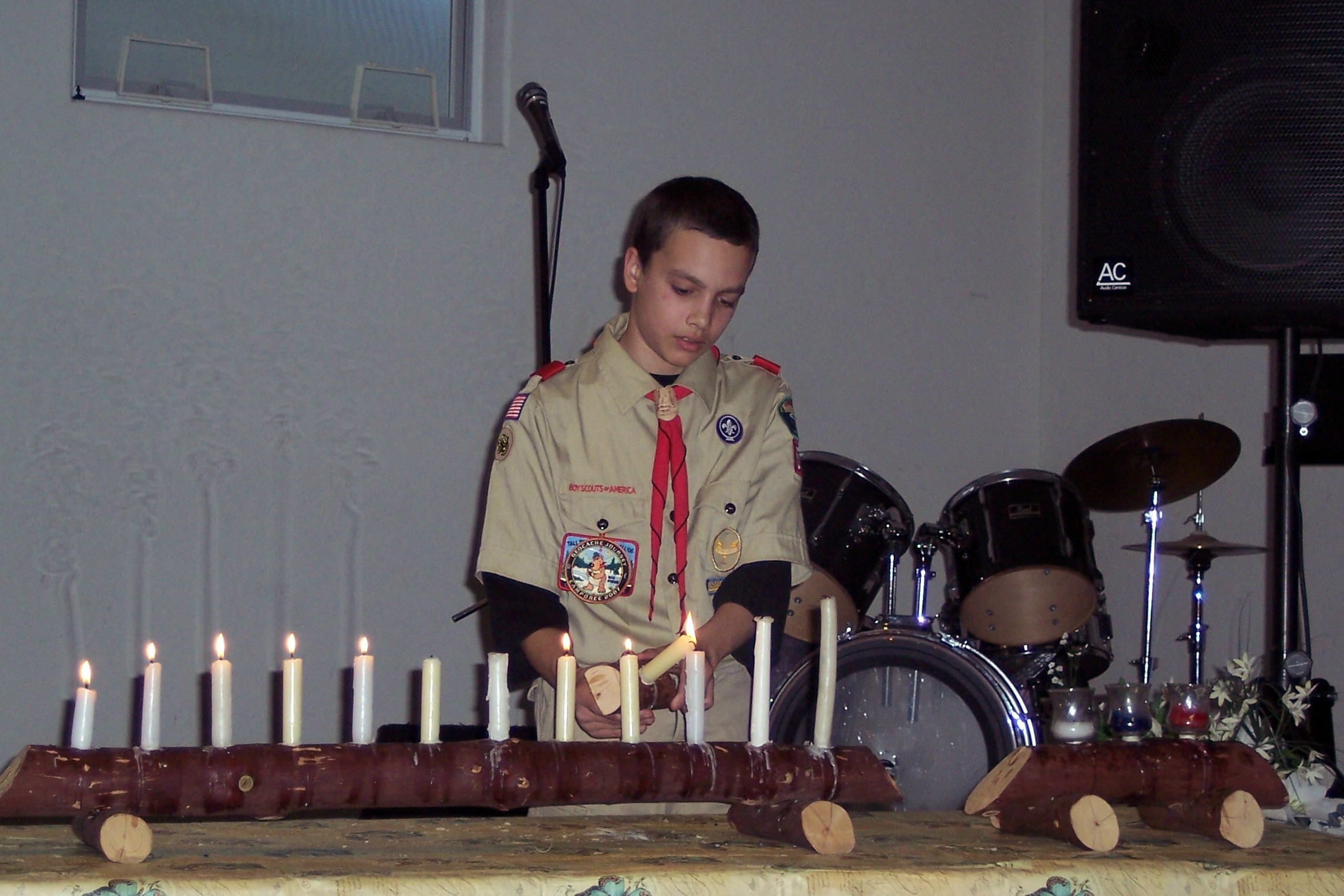
Nigel Receiving First Class Rank

Last night was an important night for Nigel! After being involved in his Boy Scout troop for two years, he has advanced to First Class rank, the mid-point on the way to Eagle.

As I have written before, our family has been involved with Boy Scouts for almost four years, and we’ve been fortunate to have gotten to know some really great Scout families during that time. All the kids just let Nigel be Nigel; they tolerate his “fake laugh” (sort of an exaggerated, cackly rendition of the laugh track on old sit-coms), they hold up his end of the flag when he can’t figure out how to hold it during the Court of Honor, and they don’t pick him to recite the Scout Law because he’s uncomfortable getting up in front of everyone. They accept him and for that I am so appreciative. (I guess they wouldn’t be very good Boy Scouts if they didn’t!)

So, he feels like he belongs, and he is slowly but surely working his way towards Eagle Scout. I don’t know if he’ll get all the way there, but he’s definitely learning and enjoying himself. And that’s the whole point.

Extroverted Autism

By nature, or by definition, most autistic people tend to be introverts. It just goes with the territory. But what happens when that is not the case? Is it even possible that a person can be autistic but also be extroverted? How? And wouldn’t that be the ultimate cruel irony? Someone who desperately wants to be social having a developmental issue that makes the very thing he wants be nearly insurmountable to achieve.

I truly believe that Nigel has struggled with this since toddlerhood, possibly even infancy. Long before he was verbal he would try, always unsuccessfully, to interact with his peers. He couldn’t talk, so he went up to them and laughed, only to be misinterpreted with disastrous results. He would try to interact with adults by going up to them and saying their license plate number. He wanted so badly to connect with people, but they were people in a world from which he so desperately needed relief. He couldn’t go into public places because he did not know how to filter all the sounds that bombarded him and caused him such agony. His sensory issues were so extreme that they – and his social issues – prevented him from being true to his social nature and his desire to be a social person.

So, Nigel evolved. He had to if he wanted to interact with people. Various therapies had a lot to do with his success, but I firmly believe that his drive to be social in the first place is what motivated him to keep trying to connect and caused him to respond to the therapy as well as he did. He somehow, over several years’ time, learned to filter out the sounds that prevented him from going into stores, restaurants, public restrooms, etc. He stretched his cognitive skills to not only repeat lines from videos he’d seen, but then he used certain lines and fit them within the context of a situation in order to express himself verbally. He wanted to communicate. It just took him several years to learn how.

It is truly remarkable what he has achieved. I have a friend with adult ADHD, and he has said that on some level he can identify with Nigel because of his own experience with learning to regulate certain aspects of his behavior. It took a lot of time, patience, awareness, and hard work, but the rewards have been well worth it.

I am an introvert. Had I been autistic, I probably would not have talked. I don’t think I would have cared. I enjoy being in my own head so much as it is that, were I autistic, I would most likely love to stay there. I certainly don’t mean to simplify the complexities of autism and the reasons why some autistic individuals learn to talk and some don’t. Nor do I mean to propose that some autistic people just choose not to talk because they are introverts.  But I can’t help but think that the way we are socially wired – introvert or extrovert – has to affect autistic individuals as well. I don’t think that autism would cancel out a person’s natural inclination to be social, if that’s in his or her personality. I see it every day with my son. He just has to try a lot harder than most people.

The Schedule

As those who teach or live with autistic individuals know, schedules are a necessary tool, not only for teaching, but for just getting through the day. For Nigel, his schedule is a lifeline, a beacon to show him the way. It has always been so. When so much about dealing with people is unpredictable, it comforts him to know what he’s supposed to be doing when (of course, this does not usually apply at bedtime).

I found this description of schedules for autistic students at Specialed.us:

Definition: A daily visual schedule is a critical component in a structured environment. A visual schedule will tell the student with autism what activities will occur and in what sequence.

  • Visual schedules are important for children with autism because they:
    • Help address the child’s difficulty with sequential memory and organization of time.
    • Assist children with language comprehension problems to understand what is expected of them (5).
    • Lessen the anxiety level of children with autism, and thus reduce the possible occurrence of challenging behaviors, by providing the structure for the student to organize and predict daily and weekly events.
    • Assist the student in transitioning independently between activities and environments by telling them where they are to go next.
    • Can increase a student’s motivation to complete less desired activities by strategically alternating more preferred with less-preferred activities on the student’s individual visual schedule.

      Example: By placing a “computer” time after “math”, the student may be more motivated to complete math knowing that “computer” time will be next.

    • For the student with autism, the consistent use of a visual schedule is an extremely important skill. It has the potential to increase independent functioning throughout his life – at school, home and community.

Without a doubt, schedules are highly effective tools. But Nigel’s schedules over the years have been much more than that. They have been a type of therapy. And I’m sure they will continue to function as such perhaps for all his life.

Yesterday I wrote about the type of homeschooling program I’m doing with Nigel and how I designed it. Here is his weekly schedule:

homeschool scheduleTime: What we are doing Monday through Thursday
8:00 alarm rings
8:10 out of bed, go to the bathroom, wash face
8:15 eat breakfast, rinse bowl
8:20 brush teeth
8:23 get dressed
8:30 start homeschool: Math: 1 pg of If Mathematics, 1 pg of Core Skills Math
9:00 Writing/Language Arts: 1 pg Quick Practice Writing Skills; Essay Writing, either 1 section with Mom or 1 pg by self
9:30 Science: go online to study topics from Grade Level Standards; take 5 footnotes from websites
10:10 snack & 10-min. break
10:20 Social Science: read books from library or go to websites to study topics from Grade Level Standards; take 5 footnotes from each source
11:00 Physical Education or Library Time
Mon: bike ride on Greenway
Tues: 15 min. yoga/15 min. push-ups & weights
Wed: walk to Phoenix library or drive to TMS library
check out 3 items: 1 social science book, 1 educational DVD, 1 book of choice
Thurs: 15 min. yoga/15 min. push-ups & weights
11:30T/Th Elective for the week (see elective list)
12:00 prepare & eat lunch
12:30 check responsibility chart & do chores for that day: when chores complete, you have free time
Ohomeschool schedulen Fridays I go into the office for a few hours, so that day has a different schedule. Nigel gets up at the same time and then takes one of the aforementioned educational videos, watches it, takes 5 “footnotes,” as he likes to call them, and then types a summary on his computer to show me when I get home. I am fortunate that he has reached a point where he will be okay for a few hours alone at home, following his schedule. Maybe it’s a lifeline for me too.

Thoughts on Homeschooling

Two roads diverged in a wood, and I – I took the one less traveled by, and that has made all the difference.

I did some online research and found (per consensus) that, in the United States, approximately 3% of students (Kindergarten through 12th grade) are homeschooled. That is certainly a less-traveled road.

But it’s also certainly one that, as Robert Frost’s immortal poem deems, has made “all the difference.” I ran into a friend today while walking to the library with Nigel, and she asked how the homeschooling’s been going. I told her that it’s the best decision I ever made.

I often get asked what type of program I’m doing, so I thought I’d describe that a bit. When I was initially researching homeschooling techniques, I discovered that there are as many different ways to homeschool as there are families who do it. The programs vary from highly structured to something called unschooling and everything in between. I decided on a structured schedule with a flexible curriculum. On any given day, Nigel and I work with the following sources: his public school-assigned math book, workbooks from Clas E. Professor, articles on Wikipedia, Kids Discover Magazine, National Geographic books and magazines, CD-Rom programs, educational videos and books checked out from our local library as well as the middle school library, and books from our own collection. We have more than enough material to work with, and aside from what I’ve spent on the books and CD-Roms we already had that we’ve accumulated over the years, this year I spent $20 on a Kids Discover subscription and $40 on workbooks. That’s it! That’s our homeschool budget! Of course there’s the reduced income to consider when figuring the real cost of homeschooling, but it’s worth it. Definitely.

The other thing I did in preparing to homeschool was to go to our state’s department of education website and inform myself about our state’s requirements for homeschooling. I also thoroughly read and noted their detailed list of grade level standards, i.e. what each student is expected to know by the end of benchmark years (3rd, 5th, and 8th grades). My goal is to follow the list of grade level standards because Nigel has expressed a desire to transition back to public school in 9th or 10th grade so that he can attend our local high school. I would certainly love for him to be able to do that, so in designing his curriculum I try to keep up with whatever the state says his peers are supposed to be doing academically. That resource was extremely helpful in figuring out what to teach him. (For anyone interested, here is the webpage with Oregon’s grade level standards for every academic subject.)

It was a bit of work designing my own homeschool program, and some financial sacrifice, but every day I see the benefits. Every day I’m glad I took this road.

Breaking Traditions

We don’t use the word ‘pajamas’ in our house. When I was growing up, clothes that we slept in were called ‘nighties’ instead of ‘pajamas,’ and I didn’t like them much anyway. I would have rather worn a t-shirt and sweatpants to bed, which I started doing in college. I had my kids do the same; it just seemed more comfortable.

When Aidan could talk (which was delayed, possibly because of having an older autistic sibling), he asked, “Why are the pants called ‘sweatpants?'”

Me: Because some people wear them when they’re exercising and they sweat.

Aidan: But we don’t.

Hence, the phrase sleeping pants was conceived. And in the summer, they wear sleeping shorts. Everything has to be labeled very literally around here.

Bedtime is always a mad dash for the boys to get everything done that they wanted to do for the day, all of their little Lego projects, stuff they wanted to look up online, as well as the requisite teeth-brushing, homework-checking, and lunch-making for the next day. As a result, they are rarely in bed at the stated time, which is as late as I can stand it because they have never, even as babies, needed much sleep for some unlucky reason.

So it’s 10:30 PM and I’m really wanting to close up shop for the night and maybe read in bed for half an hour before going to sleep myself. Aidan’s already down (required since he’s younger), but Nigel is still in mad-dash mode. He’s running out to the game room to find one last Lego piece (a Ghengis Khan-style helmet), he’s printing out a chart of the International Date Line from Wikipedia, and he’s saying good night to the cat. I order him to brush his teeth and get in bed because I want to go to bed.

I shut off the lights, check the doors, turn down the heater, and go back to Nigel’s room to say good night to him, hoping he’s ready.

Nigel: I have to put on my sleeping pants.

Me: Let me say good night to you and then put on your sleeping pants.

Nigel: I have to put my sleeping pants on before you say good night to me. It breaks my traditions.

And in the second before I respond, I think, Wow, what a beautiful sentence. Two! He can now express his needs with words instead of screaming, as he would have just a few short years ago. And I say, “Okay,” and close the door until he says, “I’m finished.”

Yes, he has his rituals. Things often need to be done in a certain order (unfortunately cleaning his room does not fall into that category). But there are many things that Nigel’s flexible about, and I can give him a minute to finish up with the rituals that he feels a need to perpetuate. The traditions. They bring some semblance of order to his often harried brain. And who am I to break traditions? Except maybe pajamas.

Lack Thereof

Yesterday I wrote a post about Nigel showing empathy without being prompted, and today I thought I’d write one to illustrate his development in that area, and how far he’s come.

Nigel has been involved in Scouting since 2004, and it has been entirely positive. He’s been in Boy Scouts for two years and was in Cub Scouts for almost two years. Three years ago, when he was ten, we were attending a monthly Pack Meeting at the elementary school, and there was a stage set up in the gym for the school’s annual talent show, which was held that same week. The Pack Meetings were typically held in the gym, so all the kids had fun climbing on the stage and play-acting. One Scout’s younger sister (about age four) slipped and somehow became wedged in between the stage and the wall behind the stage. She was stuck tight, and it took at least five minutes of planning and carefully moving the stage to get her out. One of her thighs had taken the brunt of being stuck, so it had been scraped, but other than that, she did not appear to be seriously injured, and was mostly crying out of fear.

The whole episode peaked Nigel’s interest. If I had realized the reason behind his interest and taken into account his lack of empathy, I would have stopped him from going over to the worried parents as they comforted their daughter when she was removed from the stage. I would have stopped him anyway, if I had been close enough to him, since I didn’t want him getting in the way. But he was not near me when I saw him walk quickly over to the parents, and I dashed to catch up to him to distract him before he could reach them. I arrived just as he loudly asked, “Can I see the scar?” The mother scowled at him, turned, and walked away carrying her daughter.

I, mortified, apologized to the father and led Nigel away, explaining to him that what he asked was not appropriate when people are hurt. At the time I thought the concept was lost on him. “I didn’t want to touch it; just look at it,” he persisted. But something about my response must have stayed with him. He must have absorbed it, filed it away, as he does with every other piece of information that comes his way. And gradually, over the years, he is learning to apply it, along with every other time I’ve tried to teach him about empathy, what is appropriate to say or not, and what would be the best response in a situation. He is learning that what really matters are people and how they feel. And as evidenced by what happened on the recent backpacking trip, he’s starting to do this on his own.

Emerging Empathy

One of the most difficult things to teach an autistic person is empathy. It can require years of repetition, and even then reminders are needed; rarely is an empathetic act spontaneous, at least in my experience. It’s just due to the nature of autism – inherent in the “aut” (self) part of it. And so, we have to teach them to care, and we hope that one of these days they’ll do it on their own.

This past weekend Nigel went on a two-night backpacking trip with his Boy Scout troop, and I stayed home with Aidan. Nigel usually does very well with the troop, provided they’re not doing the type of gift exchange where everyone picks a number, and the higher number-holders get to “trade” gifts with the lower number-holders, whether they want to or not. No, Nigel didn’t do well with that. He lost a giant chocolate bar that way, and he’ll never forget it (I’m sure no one else from the troop who attended that gift exchange will forget it either). But other than that, most of his outings with the troop are problem-free. I asked the scoutmaster to remind Nigel to take his medication, and off they went on a 13-mile backpacking trip.

Upon their return, I asked the scoutmaster how things went, and he said that Nigel did really well. He only took issue with having to get into a wet tent after it had rained. But then the scoutmaster told me that one of the nights he woke up to what he thought was a coyote, then he realized it was one of the kids crying. He got up to investigate and realized it was coming from Nigel’s tent, which he shared with another boy. The scoutmaster stood and listened as he heard Nigel consoling the other boy whose stomach was hurting. When the other boy said he wanted to go home, Nigel calmly stated that there were no motorized vehicles to take them home and that he should try to relax. The next morning the scoutmaster thanked Nigel for helping the other boy.

It has taken many years, with many setbacks along the way, but Nigel has reached a very important milestone: showing empathy (in a leaky tent, no less). I’m certainly not deluding myself into thinking that it will always be like this from now on, but it’s an encouraging start. It’s more than encouraging; it’s truly wonderful. He’s applying life skills without reminders, and I am thrilled.

Anger Management

Man, what a day. Just when I think things are going pretty well, thinking I can breathe a little easier, the phone rings. As an introvert, I don’t get too excited when the phone rings anyway. But when Nigel’s not home and the phone rings, I get nervous.

This afternoon, Nigel wanted to ride his bike to a neighborhood kid’s house a couple of blocks away, so I said sure, just be careful and be home by five. Less than 45 minutes later, the phone rang and it was the elementary school about half a mile away. Apparently the kid he went to visit wanted to hang out at the school, so Nigel went with him, and then he proceeded to get into an argument with the kids in the after-school club there. One of the girls said something that upset Nigel, and things escalated to the point where Nigel was so agitated that he threatened her by saying he would tear her arms and legs off, after she had called him a second-grader. I told the school I’d be there in five minutes.

If I had a dollar for every time all the schools over the years called me about Nigel’s disruptive behavior, I could certainly pay for a much-needed massage for myself. You would think after all these years that I would be used to it, that it wouldn’t rattle me the way that it does. But every time it happens I feel like I have a brick in my gut and a sense of hopelessness floods my veins. I’m so tired of it. I’m so tired of having to apologize and explain my son’s behavior to someone and wondering if it will ever change.

But this time was different. This time Nigel apologized, and without prompting. To the adult moderator of the club he said, “I’m sorry, I have autism and sometimes I can’t control my anger.” And then, on his own, he went and apologized to the girl, told her that what she said had upset him, and she apologized to him. It was like something out of a movie. Something I wouldn’t have dared to dream of.

And the brick was gone and I thought, Wow, he’s actually starting to get it. Then we went home and I talked with him about what had happened, and how proud I was of him that he had apologized. He still needs to do a lot of work in the area of letting go of an argument and the feeling that he has to “get back at someone” when they upset him, and remembering that it’s never okay to threaten people. And I know I have to prepare myself for many more confrontations and ensuing phone calls. But we made progress today. Development is always slow, but it’s there. And so is my faith in him.

Having Autism Vs. Being Autistic

For many years I could not say that Nigel was autistic. I could not say, “My son is autistic.” I would readily tell people “My son has autism,” because to me that was different than calling him autistic. The autism, I accepted. To me, saying someone “has autism” puts the focus on the person rather than the disability. Saying my son “is autistic” makes it sound like the autism is his identity.

But it is. It’s part of his identity.

It took me so long to realize that and accept it. I used to tell friends and family, “We say that Nigel HAS autism rather than he IS autistic, just like you say that someone HAS Down syndrome rather than someone is ‘Down syndromic.'” I’m sure I sounded like I was stuck in some level of denial. I was willing to admit that my son had a disability, but not acknowledge that it was actually part of his personality. 

I’m not sure what changed. Maybe it was a subconscious need to fully process the way autism affected our family. About two years ago, I started saying, “My son is autistic” when mentioning him to strangers or acquaintances. And I was surprised to find that I actually felt comfortable saying it. Sometimes I would say it by myself, quietly, in my room. I would hear the words coming out of my mouth, and with them came a sense of something that resembled peace. Autism didn’t feel as much like this formidable disability when I used that different terminology, the one I had resisted for many years. The word I had told other people not to use: autistic. It was almost a relief that now I could actually say it: My son is autistic! I realized that I had finally truly accepted the autism present in our lives because I embraced it as part of my son’s identity, not just something that he “has.”

My realization was further supported by an interview I recently came across at Natural Learning Concepts, featuring Daniel Hawthorne, a high-functioning autistic adult who was non-verbal until the age of seven. Here is his response to the issue of having autism vs. being autistic:

Do you get upset if you’re called “autistic” rather than “a person with autism?”
“Actually, I prefer to think of myself as being autistic rather than having autism. Autism is pervasive; it affects every facet of my life.  It is not just something I have in the sense that one may have diabetes or epilepsy.  Autism affects the way I think, my personality, my abilities and much more, and I accept it.”

I have come to feel the same way about Nigel. I never thought of autism as a disease (like diabetes or epilepsy mentioned above), but I seemed to think I could refer to it as such, in saying it was something Nigel “had.” I have finally come to terms with the fact that it’s part of who he is. And whether he is able to achieve the high level of functioning that Daniel Hawthorne has, or if he stays the same, or even if he regresses, Nigel will always be the amazing person that he is – my autistic son.

More Vaccines

Just when you thought it was safe to go back in the water . . .

I’m not against vaccines. But today at Nigel’s 13-year physical, the nurse informed me that he should have three more vaccinations: tetanus (with diphtheria and pertussis), hepatitis A, and meningitis. And they offered to give all three at once, as a convenience to me. I blanched at the thought.

Deep breath. As I have mentioned before, I don’t think thimerosol-laden vaccines are the sole cause of autism. I do, however, believe that they are (were – if we trust the labeling of thimerosol-free vaccines) a contributing factor to the presence of autism. A notable contributing factor, in some cases.

Nigel’s last “booster” vaccinations were seven years ago. In 2001, I don’t think I had heard of thimerosol. I think at that point, thimerosol had not been isolated as a possible culprit. There were groups of so-called fanatical parents who supposedly believed that the vaccines themselves caused autism. And I didn’t think that the vaccines themselves were to blame. So I agreed to the three boosters (did I have a choice, school district?) and unwittingly injected my son with more mercury.

And now that the thimerosol-laced vaccines are no longer being produced, I should feel fine about continuing to inoculate my son, right? On paper, I do feel okay. But something nags at me. Something makes me feel like I should avoid the vaccines. It’s just a little feeling. I wish I didn’t feel it, because I think at this point it’s irrational. It’s this “here we go again” feeling, a deja vu feeling, an I-know-better-now feeling. And I will shelve it, because I believe it when they tell me that thimerosol is no longer being used in children’s vaccines. Maybe I just want to believe it. But I sure as hell hope it’s the truth. It’s the least we deserve.

Vaccinations are never a pleasant experience but are essential when dealing with certain diseases, especially if traveling abroad. For UK readers, there are a range of vaccination services for fighting diseases at your local private clinic in London.