
Monthly Archives: March 2009

5 Ways to Feel Positive

Lately I find myself vacillating between extremes of emotion – either blissfully happy or sobbing without reason. Infinitely patient or agitated beyond control. Supremely confident or a bundle of nerves. They’re not so much mood swings as what I call “outlook swings.”

Two weeks ago, I was on top of the world, and not because of any tangible thing. I was filled with a sense of gratitude for every aspect of my life – giddy, almost. It was like I was high on gratitude, just for living. It was nice, but it was also unnatural. It was an extreme positive outlook – so extreme that it had to swing back the other way. My sadness last week came on me like a truck. Granted, I had a lot on my plate with being nervous about Nigel going back to regular school and Aidan’s mystery ailment. But I allowed that anxiety to infect other areas of my life that I needn’t have, like my self-esteem. I suddenly found myself way more negative than I am ever comfortable being. It was the other extreme. Fortunately it subsided with a phone call to a friend.

So how else do we deal with the unavoidable weepy bug? How can we regain our positive outlook when we feel like we have to take on the world (or that the world is taking us on)? My outlook swings have finally normalized (for the time being), and I think it’s because I did all of these things:

  • I realized that the kids are all right. Yes, one is adjusting to an environment that used to be very difficult for him, but at this moment he is happily watching Winnie the Pooh in his room. And yes, the other one has some unknown health issues that I’m very worried about, but at this moment he is not in pain and he is listening to Bob Marley in his room. These boys are my world. And as long as they’re okay, I can handle whatever is thrown at me.
  • I’ve got a job and a home and good health. Yes, this smacks of being told to be thankful for your dinner because there are kids starving in other parts of the world, but sometimes I have to remind myself that my life could be worse.
  • I let myself be sad for awhile. There IS a reason for it, even if I can’t see it. And even though my life “could be worse,” sometimes it’s tough enough to warrant a few frustrated tears.  And everyone always has a right to feel the way they do. So if you’re sad, own it. You do have a reason, and it is valid.
  • I called a friend. Let me say that again, because it’s not something I normally do. I called a friend. Usually I’m a go-it-alone person. I often have to force myself to ask for help. I don’t know why; it’s just the way I am. Maybe because I’ve been on my own for so long, I’ve had to be that way, even when the chips were down. But not this time. I felt the need to talk it out, and it helped immensely.
  • I recited affirmations. Nigel is calm and comfortable at school. Aidan’s body is healing. I am working toward my goals. My life is right on schedule. I enjoy life. I am where I am supposed to be.* I recite these in my mind throughout my day, and before I go to sleep. It’s also helpful to write them on Post-It notes and stick them around the house where you will see them periodically (bathroom mirror, refrigerator, wine rack).

*Note: Affirmations are generally not as effective when you’re in the middle of a crying jag.
Sensory News

Sometimes it feels like I’m playing musical chairs with my sons’ sensory issues. I never know which issue is not going to be accommodated. When the boys were younger, it was like playing musical chairs with ten people and three chairs. Hence, I did not leave the house much.

As the years have gone by, both of my sons have learned to filter their sensory input, and most of the issues are no longer as extreme for them. Nigel can go into grocery stores, public restrooms, and restaurants now. Aidan rarely throws up in the car and no longer cries 80% of his waking life. Aidan’s oral defensiveness and tactile sensitivity still affect him, as does Nigel’s sensitive hearing. And so I still tend to write a bit about sensory issues, especially if I’m describing how far they’ve come.

Since both of my boys have tactile sensitivity, I felt it was quite fitting to be interviewed recently by Soft Clothing. As the mother of two sons who hate socks and wear certain clothes for days on end because they’re the only clothes that “feel comfortable,” I look forward to trying out their line of seamless socks and tagless shirts, coming later this year. And if you’re interested, click here to check out my interview/blog profile on their site.

As for my game of sensory issues musical chairs, we seem to have a new player to add to the mix: light. Nigel’s latest addition to his bedtime routine involves putting on a pair of sunglasses and hiding under his covers before I turn off his bedroom light. He says that the sunglasses “speed up the darkness level in the eyes,” which I assume refers to his adjustment from light to dark, just as his eyes need to adjust in the morning from dark to light. Of course, I think most of us fall into the latter category. But the adjusting from light to dark is a bit different. Perhaps it’s a transitional thing, and transitions of any kind have always been hard for him. Either that or he’s been listening to that old “Sunglasses at Night” song. Lucky me!

When Talking Is a Problem

For my recent trip involving air travel, Nigel accompanied me to the airport before I left. He flew for the first time three years ago, and he loved it. I had brought ear plugs for him, and he didn’t even use them. He was far too excited and motivated to have mechanical noises bother him that time. He loves to learn about other countries, reads National Geographic every month, and longs for the day when I “sell lots of books” so that I can take him to see Stonehenge and the Acropolis, among other places.

And so, he loves to be in airports, which he doesn’t get to do very often. Being an extrovert, he wants to interact with people. I could not have guessed however, that upon entering the airport he would have made a beeline for the guard at the entrance to the security check area. I had my bags and was giving instructions to my mother, who watched the boys that weekend, and I didn’t notice that Nigel had taken off until I scanned the area and saw him leaning in to the guard and saying something. Like a rabbit caught in the headlights, I froze. The guard had an odd look on her face.

Nigel walked back over to me. “I told her to keep up the good work because we don’t want another 9/11,” he said, satisfied with himself.

How could he have known? How could he have possibly known that what he’d said was unacceptable talk in an airport? How could I have thought ahead to tell him not to say things like that? I spend at least half my time anticipating inappropriate things that Nigel could say and then explaining to him that it’s not okay to say them. Saying inappropriate things can be a huge problem for the verbal autist, even a liability. It can hurt people’s feelings and actually get him in trouble, especially since he rarely makes eye contact and often speaks in monotone. I try to circumvent these potential problems by thinking ahead and coaching him, really trying to understand his way of thinking, anticipating what he might say, and helping him to avoid saying the wrong thing.  

I mentally wrung my hands, hoping that we wouldn’t have a security squad swooping down on us at any second. And my heart ached for my poor son who was just trying to make conversation, who absolutely did not mean any harm.

“Oh, honey,” I began, “I know you thought you were trying to encourage the guard, but it’s not okay to talk about 9/11 in airports. It alarms the security guards because they think of it as a threat or a joke, even though I know you didn’t mean it that way.”

A dejected look washed over his face. “I thought I was doing something good. I was telling her she was doing a good job.”

“I know, sweetheart. But they might not see it that way, and it could get you in trouble to talk about 9/11 in airports. So try not to do it anymore.” I looked around, wondering if the guards had their eyes on him. I had to keep him close to me, this boy who is taller than I am. Maybe somehow, if they saw a mother sticking close to her teenage son, they would know. They would see his “difference,” as he calls it.

“I didn’t know,” he said, looking down.

“I know. I wish I had thought to tell you, but I’m telling you now. I know it’s hard to understand, but you just can’t talk about 9/11 in airports, even for good reasons.”

“Okay,” he said quietly, seeming to understand, or maybe just accepting it without understanding.

Oh, my son. He tries so hard.

Empathy Vs. Logic

The Scene: Older brother is getting ready to go to his weekly Scout meeting. He is in the living room, uniform on, tying his shoes. His mother is cleaning up the kitchen after dinner. Over the din of the clanking dishes and running water, we hear the younger brother, who is wrapped up in a blanket on the couch and appears to be sick.  

Younger brother: Tonight at your Scout meeting, could you not tell anyone about what happened to me last night? I don’t want all of them to know.

Older brother, standing up: Okay. But what’s the point of being able to talk if you have to keep secrets?

Look Me in the Eye: A Review

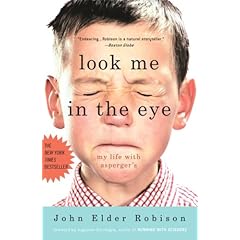
I realized recently that I hadn’t done a book review in a long time, and since last week I had the privilege of meeting and talking with John Elder Robison, I decided to write a review of Look Me in the Eye.

The quote across the top of the cover (actually, the boy’s forehead) says it all: “Endearing . . . Robison is a natural storyteller.” And that is exactly what’s so enjoyable about this book – his stories are captivating and entertaining. I loved reading about stories ranging from tricks he had played on a teacher who was mean to him and how he raised the money to do so, to how he got started restoring cars and taking radios apart, to how he got interested in guitars and amps and began working on them, which eventually led to his work with KISS. He tells stories about how he met his first girlfriend, how he interacted with his brother while growing up, and dealing with unstable parents. Reflected in all of his stories is a sense of empathy and his longing to connect with others and relate to them.

My favorite parts of the book include the chapter describing what it was like for him to be at a huge KISS concert, observing the magic of the lighting system that he designed and built. It’s an incredible passage written with details that made me feel like I was there, experiencing it. Definitely a must-read, along with the empowering chapter in which he figures out the cause of a major problem in one of the electronic toys manufactured by Milton Bradley. I also enjoyed the chapter which features Robison’s analysis of his process to develop socially and emotionally. His insight is remarkable, and anyone – parents of ASD children or not – reading his book has much to gain from it. I especially appreciate how he pointed out that child psychologists who observed “John prefers to play by himself” were completely wrong. The fact was that he did not know how to play and connect with others, not that he didn’t want to. It’s something that my son also struggled with, and continues to.

I loved reading about how Robison interacts with and teaches his son, the bond they share, and how he made peace with his parents later in life. The myth that people on the autism spectrum are not emotional is completely blown out of the water with this book. In the Postscript included in the paperback edition, Robison concludes with a plea: “I may look and act pretty strange at times, but deep down I just want to be loved and understood for who and what I am. I want to be accepted as part of society, not an outcast or outsider . . . I wish for empathy and compassion from those around me . . . I hope you’ll keep these thoughts in mind the next time you meet someone who looks or acts a little strange.” I will indeed. In fact, I already have. Look Me in the Eye is a fascinating story of life with Asperger’s – and being human. I highly recommend it.