Monthly Archives: January 2009

I Heart Echolalia

practice

I’ve seen some great posts on echolalia around the blogosphere lately. One point in particular that I keep thinking about was from Maddy’s post, in which she mentioned that someone had found her blog by searching “methods to stop echolalia.” Yes, it can be annoying sometimes, and maybe completely random, but hey! Your child is talking. Do you get it? Why would you want to stop that?

I have written about Nigel’s language development through various stages of echolalia. Yes, there have been times in recent years when I have prompted him to use his own words instead of a memorized phrase to communicate, but that’s because I know that he now has the ability to do that, to use his own words. Echolalia is comforting to him, however, and he reverts to that in high-stress situations. And in those situations, it’s more important to help him to calm down than to stop the echolalia. I don’t tell him “You can use your own words” when he’s on the verge of a meltdown. But sometimes, when he’s calm and comfortable, I encourage him to rephrase whatever he’s saying. I’ll gently suggest, “You don’t need to say things from videos right now. Try to tell me in your own words.” And he does now, because he’s able to. But I would never want to take that part of him away completely. He’s said some really funny things because of his delayed echolalia (scripting)! It’s how he learned to talk, and for that reason, I’m sentimental about it.

Why on earth, when a brave child is venturing into the speaking realm, would someone want to stop echolalia? Let them do it! Let them practice! When someone is learning to play the piano, there is a lot of bothersome plinking and plunking going on, usually on a daily basis. But after a long time of that, a song emerges, sometimes one that they have composed themselves. And there will still be plenty more plunking and plinking as the years go by. But also – we hope – more songs.

To Med or Not to Med

The term “self-medicate” has a negative connotation.  It makes me think of alcoholics or drug addicts, both prescription and illegal. Yet, taken literally, the two words simply mean to administer medicine to oneself. Or to want to.

Nigel and I saw his doctor – his psychiatrist – today. He goes in every couple of months for his “med-management” appointment. He doesn’t like these appointments because he doesn’t like answering questions about himself (really, he only likes answering questions about Indiana Jones, or Lego, or the JFK assassination, or either of the World Wars). And even though I prepared him ahead of time, reminding him that the doctor is required to ask these questions and that he could write the answers down if he didn’t want to say them (“Why would I want to write anything, which would cause pain to my hand?!!”), he still got impatient with the questions and often sneered his answers. Or instead of actual answers, he would sneer – in reply to “How would you rate your mood today?” – “Same as it was last time!!

This level of verbal hostility probably encouraged the doctor to nod in agreement when I indicated to her Nigel’s desire for some medication that would help him to not blow up at certain peers of his who think that it’s fun to antagonize him. He wants something to control his tendency to respond in anger because he wants to go back to being mainstreamed. And he knows that that is his most difficult hurdle. Not because anyone told him, but because he actually has the self-awareness to see it. Yet, he does not have the ability to control his reactions to people when they upset him. So, he wants medication. He knows that medication helped him to stop habitually pulling out his hair and eating it, so he figures that medication can help with his behavioral issues. He wants to self-medicate.

And I had done my research and knew what the doctor would suggest: antipsychotics. There’s another negative connotation. Is that really what he needs? Are the occasional times that he blows up worth putting him on a daily medication with significant side effects? I asked him, there in the doctor’s office, gently, “I know that some of the kids bothered you every day, but did you respond with anger every day?”

“Yes. Every day.”

I took a deep breath and tried to let what he’d said sink in. It was too difficult to imagine, again, what he went through at school, day after day, and to think that in spite of that, he still wants to go back. He wants to be like everybody else.  It means that much to him. But I still wasn’t ready to say yes to antipsychotics. So I suggested that he try behavioral therapy to learn different responses when his peers anger him.

“I don’t want to see more psychiatrists,” he said, right there in the doctor’s office. “They’ll do the same kind of treatment!”

His psychiatrist smirked as she wrote that down. I asked, “What kind of treatment are you expecting from the psychiatrists?”

“Asking me questions!” And, of course, the psychiatrist politely laughed.

But the issue was still hanging over my head. He wants to change his behavior but he can’t handle therapy sessions. So, the doctor went and got several pages’ worth of printed material for me on the two medications she suggested as possibilities (Risperdal and Abilify). She gave me her cell number if I wanted to discuss anything with her. And I left feeling just as unsure and melancholic as when I’d arrived.

Right now Nigel is sitting on the couch in the living room, watching The Never-Ending Story III, which he was excited to rent tonight. Most of the time, I hear the faint sounds of the TV, which he keeps at a low volume, but once in a while he makes stim-type sounds or repeats one of the lines of the movie. He is happy; he is doing his thing. And he is not on antipsychotics. I wish it could always be that way.


Sense of Humor Intact

Nigel is now completely well. Generally, we don’t stay down long, but the reasons that I know for certain that he’s well are the following:

a) He is playing with Lego in the living room

b) When I ask him, before dinner, to pick up the Lego, he says this to me—

“Are you developing a sense of humor or am I going deaf?”

Granted, this is probably a line from a movie that I haven’t seen or don’t remember, but still. He’s definitely not sick anymore.

Sick Bay

That nasty stomach-bug thing that’s been going around has made its way to our house. Right before bed last night, Nigel ran to the bathroom to throw up. I thought at first that it was because (I’d discovered) he drank way too much soda that afternoon and evening while I was working in my office. But typically if his stomach’s upset for that reason, it’s a one-time elimination deal. And, unfortunately, Nigel’s trips to the bathroom occurred several more times throughout the night.

Usually, he makes it on time, but at one point in the wee hours, I heard him (the sound at which all parents groan) and went to check on him. It wasn’t pretty. I cleaned him up, got him back in bed and reminded him about using the old pot that I’d put by his side for the next episode, and then cleaned up the carpeted hallway, the bathroom door, sink, mirror, and floor. I didn’t even want to know what time it was.

Nigel has always been a trooper when it comes to being sick. Even as a young child it didn’t seem to faze him. He never whined about being sick – he just took it. He’s still the same way. And he loves saltine crackers, which I only buy when the kids are sick. I think it’s like a consolation prize in his mind – he requested the saltine crackers moments after he vomited his entire dinner. Not yet, I told him. Your stomach needs to rest. I’ll get you some tomorrow. And he accepted that. His stomach probably made him sense that it was best to wait.

Fortunately, though, our family doesn’t get sick much, especially in recent years. Two and a half years ago, we started eating organic food. Not everything – in fact, probably about half of the food we consume is organic – the stuff that we eat every day. But it really makes a difference in our health. In two and a half years, both boys have only been sick twice, and it was mild – over in two days. I’ve only been sick once, also mildly.

But still, even in my children’s teen years, I’m cleaning up puke. At some ungodly hour, no less. Afterward, I manage to get a little sleep. In the morning I get up and get Aidan off to school, check on Nigel, empty and clean out his used pot, wash my hands, and come in the office to work. Suddenly I hear retching sounds in the hallway right outside my office door. It’s one of the cats, about to yak on the carpet. I leap up from my desk and grab the poor thing, herding him into the bathroom and holding him over the linoleum. Then I clean that up, laughing at the fact that I have cleaned more puke in the last nine hours than I have in the past four years. I wash my hands for about the thirtieth time, put on my shoes and coat, and go out to buy non-organic saltine crackers. And maybe a new mop.

Ode to Lego

When Nigel was first diagnosed at age three, and for some time after, he didn’t know how to play with toys. I bought him a kids’ train set; he laid his head to one side and stared at the tracks. He had no interest in pushing the train along, even if I showed him how. I bought him Hot Wheels cars and tried to teach him to “vroom” them around on the floor; he lined them up end-to-end along the back of the couch and cocked his head to one side to stare at them. I feared that his imagination would never develop; eleven years ago my only knowledge of autistic adults was, unfortunately, limited to Rain Man. I didn’t know what to expect for my son’s development.

But, thanks to a successful response to a modified ABA-based program for early intervention, and perhaps his own desire, Nigel learned to play with toys. He skipped over “vrooming” on the floor and went right to faster-paced, battery-operated Hot Wheels tracks. His imagination began developing with his desire to feed his stuffed animals. And then he discovered Lego.

I cannot say enough wonderful things about this toy that I loved in my own childhood. Yes, we’ve all gouged our feet on errant pieces and cursed its existence, but the fact is that no other toy has encouraged Nigel’s imagination to develop as much as Lego has. And for that, I love it.

And we have tubs of it. Literally. We progressed from a medium-sized tub to two of them, and then I just up and bought a huge industrial-sized tub with a hinged lid, which is now full. And still Nigel begs for more, especially since they’ve come out with the Indiana Jones series. Oh, my son. Be still, his heart. Lego and Indiana Jones – two of his favorite things. That’s all he wanted for Christmas. It’s like the Lego people somehow knew that this combination would make an autistic teen very, very happy.

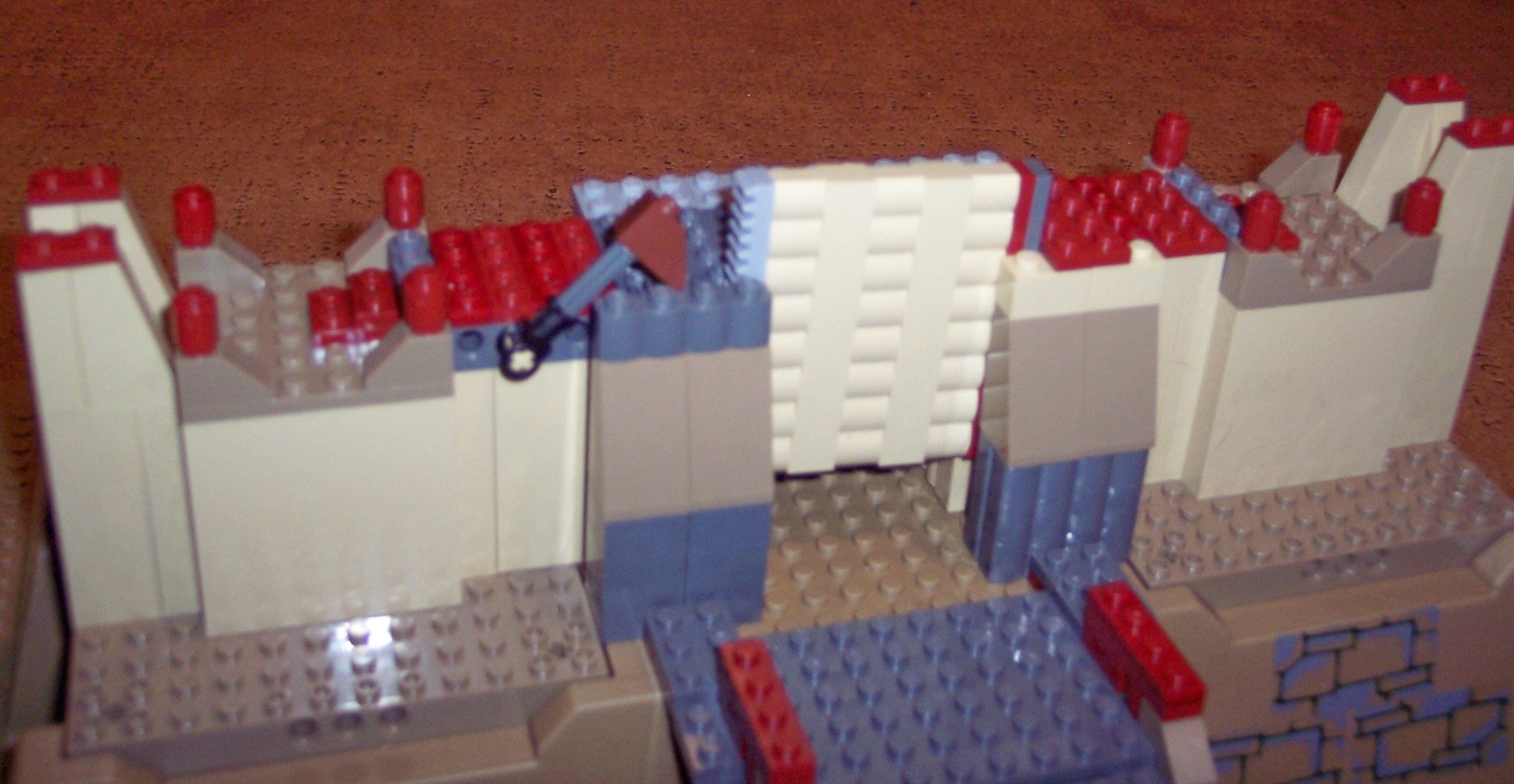
So I bought him the sets that he wanted, as well as this book that he has not let out of his sight. Of course he has re-watched all four of the movies several more times since Christmas, just to make sure that he has all the nuances of every line down pat. And so, when he decided to watch the Troy DVD this afternoon, I was pleasantly surprised. “I’m studying the layout of the outer walls of Troy so that I can take apart the Temple of the Crystal Skull set and build Troy,” he told me.

Nigel\'s Lego Troy

And that, my friends, is what he did. He constructed the ancient city of Troy out of Lego, completely off the top of his head and of his own design. He built a wall with a ratcheted gate and levers to open it. Yes, he even built a Trojan Horse out of Lego. That is either one hell of a toy or one hell of an imagination. He’s come a long way from lining up Hot Wheels cars along the back of the couch and staring at them. And Rain Man? No offense, but you can keep your cards and toothpicks. Nigel’s got an imagination – and he’s not afraid to use it.

New Year, New Behavior

Often at the start of a new year, we note things that we would like to change about ourselves or our lives. We make resolutions and take steps to lose weight, be healthier, save money, or achieve a goal.  We are determined to improve.

Yesterday, I began preparing Nigel for his doctor appointment at the end of this week. He tends to detest these medication-management appointments, being asked to rate his mood, and answer other questions that he would rather not. So I thought that I’d prepare him a few days ahead of time, asking him some of the questions that I recall the doctor asking previously, so that Nigel can start thinking about his answers. “How would you rate your mood?” I asked.

“Fine,” he answered as usual. Then he added, “But I don’t see any changes.”

Surprised and intrigued at this part about “changes,” I pressed further. “What changes are you hoping to see?”

“My behavior. I want to not get angry so much so that I can go back to regular school.”

And my heart thumped as I understood what I had always wondered. Even though Nigel is much calmer with homeschooling than with mainstreaming, he is an extroverted autist, and he misses being in a more social environment. Even though he is regularly involved in Boy Scouts and attends a weekly social skills class, it’s not enough for him. He craves more. The sad part in all of this is that, because of his autism, he usually can’t handle more. It is very difficult for him to regulate his behavior and emotions. He is learning, but I’m hoping there is some medication that can help him with this. He has been on Zoloft to help with his OCD symptoms and anxiety, and that has been beneficial. I explained to him that the medication that he’s been on is not designed to help with behavior modification, but that there might be medication available that can help with that. One of his problems is that when kids do or say something to purposely agitate or upset him, he blows up, and he’s not able to regulate himself. Then he ends up getting in trouble, and it becomes a vicious cycle, because it’s fun for the bullies to upset him. Suggesting to him that he “ignore” them does not work for him. He is not able to ignore them (in my opinion, they should not be doing it in the first place, but that is another issue).

I don’t know if there is a type of medication that can help him with his behavior. We’ll be discussing it with his doctor, but if any readers have any suggestions, please let me know. I’d love to have Nigel be able to attend the local public school, at least part-time, because it would mean so much to him. His new year’s resolution is to go back, and I want to help him achieve that goal.

An Open Letter to 2009

Dear 2009,

Welcome! We’re glad you’re here! 2008 was a hell of a ride, but don’t think that you need to do any one-upping to impress us. Not at all. We’d like it just fine if you can keep things mellow.

I suppose I should define ‘mellow.’ You see, in a house where autism resides, we already have a lot happening on a day-to-day basis. We have a 14-year-old autistic boy who learned to talk but has trouble regulating emotions and behavior, navigating social interactions, dealing with sensory integration, and understanding the purpose of education and how it relates to him. We have his mother who is trying to homeschool him and work two jobs and manages to write something, cook something, and clean the house every now and then. We also have his sensitive 12-year-old brother who is figuring out his place in all of this.

So by ‘mellow,’ I mean that we don’t need people getting lost or hurt, trees catching on fire, pets getting hit by cars, computers and – heaven forbid, the Xbox 360 – crashing, furnaces going out, or bouts of food poisoning. We don’t need any more loved ones dealing with cancer or getting in car accidents. You might be thinking that I’m being negative or critical of 2008, but I don’t mean to be. 2008 was in many ways a positive year, with some big forward strides, and we learned a lot. We are more resilient and capable. All things considered, we are happy.

And we’re looking forward to a great next year of life – a year full of goal achievement (including a graduation), enriching experiences (including a problem-free trip to the Grand Canyon), and even a new nephew/cousin! We have great expectations of you, 2009. And we think you’ll do just fine.

Best wishes,

The Teen Autism Household