Monthly Archives: November 2008

Becoming Adaptable

The reasonable man adapts himself to the world: the unreasonable one persists in trying to adapt the world to himself. Therefore all progress depends on the unreasonable man.              -George Bernard Shaw

Yesterday we went to our local Family Fun Center, where Nigel loves to drive the go-karts. As we were en route, the sky clouded up quickly, and it started raining before we even got there. When we pulled up, I looked over at the go-kart area and could tell that they were not running. “Well, guys, the go-karts are closed,” I announced. “That’s okay,” Nigel said. “We can go in the arcade.” Adaptability score: 1

I don’t know how Nigel filters out all the sounds, lights, and people in a busy arcade, but he does. I think it’s because it’s something that he really wants to do, so he’s motivated. Or, it could be because there’s so much going on that even his brain can’t isolate all the sights and sounds, and so it’s just one big bombardment to tune out. But somehow he’s learned to deal with it. Adaptability score: 2

Nigel, having a lower emotional age than other 14-year-olds, has always enjoyed climbing and sliding on play structures. You know, the indoor ones that usually have a height limit of 48 inches, which Nigel surpassed a few years ago. He sometimes rationalizes: “I can go on it because it’s not crowded.” But he is now at an age and size which makes it inappropriate for him to continue playing on the indoor play structures, and doing so could even get him in trouble with people who don’t realize that he’s an 8- or 9-year-old in a 14-year-old’s body. He could be seen as a threat. So, I figured it was time to break him of this habit. He asked, as he usually does at the Family Fun Center, if he could go in Cactus Jack’s Playhouse. I non-confrontationally posed that he might be too big for it, and I suggested that he ask if there was a height or age limit. He came back a moment later and said, “Twelve and up. And since I’m fourteen, I can go in.” “I think it’s twelve and under,” I said gently.  “But I really like it,” he said in a quiet, forlorn voice. “I know, honey, but you have to realize it’s not built for kids your age.” He looked down and said, “Okay.” Then he looked up and asked, “Will you play air hockey with me?” Adaptability score: Bonus 10 points!

Such a “reasonable man” my son is becoming. And a good air hockey player, too!
Just One Wish

A few weeks ago I wrote a post regarding a survey (taken by Natural Learning Concepts) that I found to be discussion-worthy. They recently posted the results of another interesting survey:

Over 5,000 people have been asked this question.  The results of the poll are:

If you could pick ONLY one of these for your child/student, what would it be?

1. A superior educational program with well trained staff – always 33%
2. A really good friend – always 37%
3. Excellent conversation skills throughout life 14%
4. Great behavior and enjoys staying focused – always 16 %


The results do not surprise me. I participated in this survey, and I did not have to think twice about what I answered. As important as #1, “a superior educational program with well-trained staff,” is for any special-needs child, as a parent, I chose #2, “a really good friend – always,” as what I wish for my autistic son.

Numbers 1, 3, and 4 help our children to succeed, and to feel comfortable and capable. But #2, far more than the other three items, helps our children to feel valued. To feel like they matter. And, in a roundabout way, feeling that way will help them to succeed, and to feel comfortable and capable. Having real friends boosts self-esteem like nothing else. I have seen how happy my son feels when he is accepted and appreciated for who he is, and if I had to choose one thing out of that list for him to have all of his life, that is it. A really good friend – always. We should all be so fortunate.

Scouts Are the Best

Last night Nigel had a Scout meeting. I was a bit apprehensive because the last meeting did not go well, meaning Nigel’s behavior. And because I could not pinpoint what had caused his step backward, I worried that he might continue down that road.

But as I have come to learn, autism is nothing if not unpredictable. Inconsistent. And so I shouldn’t have been surprised when Nigel did really well at the meeting last night. He didn’t interrupt anyone, he only got in someone’s face once, and it was brief, he participated and paid attention. He even requested, appropriately, to show the other Scouts something he had brought with him. He needed to bring it in from the car, and the Scoutmaster said that he could do that near the end of the meeting.

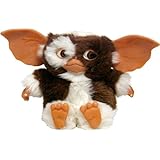
And that’s when I got a little nervous. He wanted to show them a little stuffed animal toy that he had received for his recent fourteenth birthday. It was Gizmo, from the movie Gremlins, and he had barely let it out of his sight since he received it Friday night. He had been sleeping with it every night; he brought it with him to his social skills class on Monday. I knew that someone with an emotional age of eight or nine couldn’t realize that typical twelve- to fifteen-year-olds would not find his little stuffed animal to be nearly as intriguing as he did. I wondered what sort of a response to expect from them.

When the time came, Nigel went out to the car and retrieved Gizmo. He reentered the room with it hidden under his jacket and made a big deal out of keeping it a secret until he was ready to reveal it. Of course the boys were wondering what he had under his jacket. A fascinating geode? A live animal? They kept prompting him to show them, and finally he did. I held my breath.

Gizmo

I needn’t have worried. Once he identified what it was, they all said, “That’s cool, Nigel,” and he took it around the room so all of them could look at it, which they politely did. They did not speak to him in a patronizing manner. They did not roll their eyes or make disparaging remarks. They got it. They realized that this was something important to Nigel, and they were supportive. And I wanted to hug all of them.

So here’s a big shout-out to the Scouts of Troop 535 and their parents: You guys are so great. You make Nigel feel accepted, and he appreciates it, and so do I. Thanks so much for your patience and understanding. It means more than you know.

Killjoy

Nigel (looking at the new watch he received for his birthday): It’s been eighteen hours, six minutes, and thirty-seven seconds.

Aidan (without looking up from his book): Huh?

Nigel: I’m counting the hours, minutes, and seconds.

Aidan: Since what?

Nigel: Since today started.

[Aidan does not respond.]

Nigel (trying to pique his brother’s interest): This is American machinery we’re dealing with.

Aidan (without skipping a beat): It was probably made in China.

Adventures in Puberty, Part 5

When I left the Autism and Puberty seminar I recently attended, my head was swimming with all the information I had obtained. I had learned about the difference between puberty and adolescence, that there is nothing delayed about the former and that the latter usually is. I learned how to teach about difficult topics like sexual abuse. I learned how the concept of emotional age affects how a child responds to puberty and adolescence. I learned what to teach older ASD teens when they do reach adolescence. There was quite a bit of information to absorb, and I knew that a good deal of it would require some follow-up.

The seminar presenters thought of everything. They provided a list of resources with a wealth of information and tips.

Books:

Websites: