Monthly Archives: July 2010

Summer Blues

Is summer over yet?

Don’t get me wrong. I’m a heat-seeker. I thrive on the warmth, crave it all year. So I love the weather. But I hate missing my kids.

This is their ninth summer in Los Angeles with their dad, 700 miles away from me. For nine summers I have sat at my desk and stared at their pictures and talked to them on the phone. My “conversations” with Neil haven’t always been on track, but he’s gotten better as the years have gone by. And I’m just glad that he has the ability to talk on the phone in the first place. Because that wasn’t always the case. These nine years have brought so many changes.

So I sit here, looking at my desk photos, clicking through summer posts from 2008 and 2009, wondering what the heck I wrote about when my kids weren’t even here. I wrote about several phone conversations, and I did a series on Neil’s early development. I wrote book reviews and posted about miscellaneous autism and special needs topics. Last summer I wrote about my incredible trip to Nepal for autism education.

But this summer I find myself at a loss for material. My main sources of inspiration are not in my presence to say funny or profound things. Our phone conversations consist of what-did-you-do-today and I-miss-you and the occasional movie idea/obsession monologue.

But the real reason is that I’m not at my emotional best right now. I’m disjointed without my boys, I’m disappointed that my moving plans aren’t coming together, and I’m disheartened in general. Plan B will go into effect soon, and it’s a letdown. I can dress it up and say that I’m hopeful, but it’s not at all what I had hoped for. It just doesn’t seem right – or fair – to have the blues in the summer. But I do.

Photo: Late summer, Crater Lake, Oregon

The Different Card

As is common in many autism homes, we had PECS cards all over the place. We started using them when my son was three years old and sort of phased them out of use by the time he was ten or so. And they were a godsend. We could tell him when we were going somewhere, he could tell us what he wanted, or we could tell him what needed to be done instead. We could use them to make visual schedules so that he could anticipate what would happen when, to ease his anxiety. And one card that we used quite often was the Different Card. If the day’s plan deviated from the norm or what he was used to, we would show him the Different Card with the two arrows pointing in opposite directions, and he could process the change. Even in his non-verbal days, we’d show him the Different Card and once in a while he would just nod slightly in acknowledgement and then keep moving, seemingly unfazed (although usually the presentation of this card was met with howls of anxiety). He knew something would be different, and he mentally prepared himself the best he could.

We’re three weeks into July. I thought by now I’d be writing about how crazy-busy I am with packing my home, downsizing a four-bedroom house into a two-bedroom apartment. I thought by now my house would be sold. I thought by now I’d know where my children would be going to school in September. I thought by now at least some of the unknowns would have revealed themselves.

But really, I had only hoped. After all, how realistic were any of my thoughts? And hope, though fervent, is still wishing. Sometimes I feel foolish, sometimes resigned, often dejected. When things aren’t going the way you’d hoped, how else should you feel?

It’s hard to keep at it, to remain hopeful. But I’m a long-time special-needs parent. My son has taught me to believe, and I am a champion of hope. It’s what I do, what I’ve done all along. My major moving plans are not going the way I’d hoped, but regardless, I know that life will work out the way it should. It always does, whether I worried or not. Whether I planned or not.

And that’s when the other thing that we do best comes into play – when things don’t turn out as we hoped they would, we adapt. We go with Plan B (or come up with one on the fly) and keep moving, because that’s what we’ve always had to do. That’s our life. And whether it feels that way or not, I think that’s actually pretty hopeful.

As for my situation, what will be, will be. It will be different than how I’d thought, but that’s okay. I know different; I can handle different. My son has trouble handling different, but we’ll get through it. I’m not sure if the Different Card will work as well this time (or if I even still have it), but he’s come a long way since his non-verbal days, and maybe he’ll just nod his head and keep moving, like he did all those years ago.

I’m hoping.

Surrender

It would be almost impossible to enumerate the many things we learn from our children, particularly those who have special needs. Infinite patience, for one. Hope. Perspective. Appreciation. Acceptance. Love. And maybe a thing or two about dinosaurs or natural disasters.

But with each of our children, special needs or not, if we really stop to think about it, we might find that one thing stands out above all else. The one thing that we really needed to learn from them, and from them alone. I wrote recently that what I have learned from Neil is the power of belief.  More than anything else, every day of his life, Neil has taught me to believe. But what I have learned from Adam is just as valuable.

In a word – surrender.

We’re not conditioned to view surrender as a good thing. To most of us, it means giving up. But to me, surrender means letting go. It means letting go of that which I cannot control. It means letting go of expectations. It means accepting What Is. And it’s something that Adam, even more than Neil, has taught me every day.

*

Unfortunately, I don’t write as much about Adam. This website is called Teen Autism, and Adam was never officially diagnosed on the spectrum. He did, however, experience a significant delay in language development, necessitating speech therapy until almost age ten. But what really affected him – and still does – is his sensory processing disorder. He must have been miserable as an infant, toddler, and even a preschooler. It wasn’t until age five that he seemed to be somewhat at home in his body; he was finally talking and smiling more often than crying and yelling.

But his eating issues continued to get worse. Whereas I would call Neil a picky eater, Adam is a limited eater. A year ago, as he was nearing 13, I started to realize that it seemed to be a control issue with him – not to control me, but to have some control in his life. He couldn’t control that his dad, whom he idolized, lived 700 miles away. He couldn’t control that he had an autistic brother. But he could control the food that he decided to eat. So what started off as a sensory issue developed into something even more involved.

And it bothered me greatly, not just because I worried about his health and his growth. It bothered me that I couldn’t just cook dinner for my child and he would eat it. Even at age 13! It bothered me that he was a teenager and, like his brother, should have been eating me out of house and home (even though Neil is picky, he still manages to eat a variety of foods, and in mass quantities). And it bothered me that Adam would eat more food when he was with his father. I took him to see a counselor, and he fought me, saying, “You’re making me do something against my will!” I compromised, telling him that if he increased his dinner choices to seven things, one to rotate each day of the week, that we would stop going to the counselor. He reached that point within three weekly sessions, and although I followed through, he has since lapsed to five or six items on the rotating dinner menu.

So I surrendered.

I let go of my expectations about Adam’s eating habits. I let go of my expectations about how he responds to having an autistic brother (hint: it’s not always noble or gracious; in fact, usually not). I had to surrender. I had to. And I thought that if he could spend more time year-round with his dad that he might start eating better when he’s with me, too.

*

He has been with his dad for over three weeks now. I’ve talked to him several times, and the last time I did he told me, with excitement and pride in his voice, “I’ve been trying lots of new foods, Mom! I’ve been eating a lot.” And I told him, choking back tears, that I was so glad to hear it.

And someday soon I will tell him that there is nothing I wouldn’t have done to help him to be as happy and healthy as possible. I will tell him that it’s okay that he’s not always glad to have an autistic brother, that I honor his feelings. I will tell him that I accept the fact that he eats differently. And I will tell him that I have become a more balanced person because of it, because of learning to surrender.
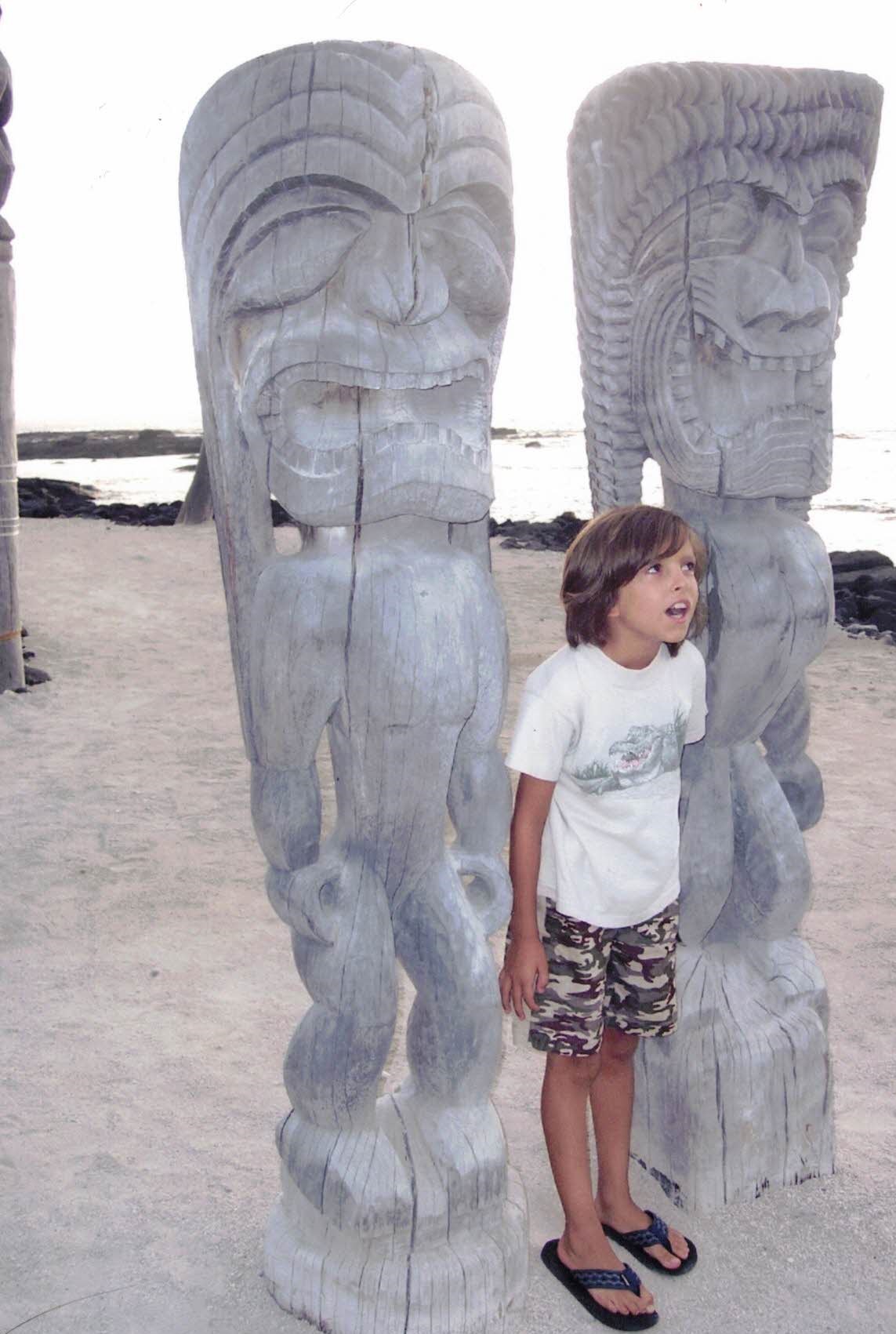
Adam, age 9, being a tiki at Pu’uhonua National Historical Park, Hawaii, 2006


Ninth Grade: A Review

I had this great idea many years ago. At the end of every school year, I would write a review of how that year was for my two sons, a separate entry for each, describing not only their progress but also their personality, their likes and dislikes, and things they said or did. As a writer, I figured that was the least I could do.

So, that idea lasted about two years. Life sort of got in the way, along with other writing endeavors. I had always meant to pick it back up again but never did. Then I started blogging, mostly about my children’s development, and I feel better about all those years that I didn’t write about the kids (although most of those years were documented in IEP paperwork). Their development is described in detail in over four hundred blog posts. I no longer feel like I should write about them individually once a year, because I write about them all year long.

But this year was a milestone year with Neil starting high school and making some incredible social gains, and now that we’ve reached the end of the first year, I thought I’d recap the highlights:

September: Neil advocated for himself for the first time at an IEP meeting and learned to safely and responsibly ride his bike to and from school independently.

October: Neil turned 15 and wrote a guest post. Also, he and I had a difficult discussion about not learning to drive yet, he successfully used his cell phone for the first time when he had a problem with his bike, and he revealed that, after many years of self-loathing, he is learning to accept his autism.

November: Neil, for the first time ever, joined a sports team, and my heart soared at his achievement. In other news, he prepared and drank a pizza smoothie.

December: Neil’s language skills took a step back (or sideways) with some lengthy delayed echolalia, and then dramatically forward with the most amazing conversation I’ve ever had with him.

January: Neil (with Adam) took his first solo flight! A mere week later, I overheard his first unprompted thank you! However, the month ended on a sad note due to his needing to quit the wrestling team for unfair reasons, but he handled it with the utmost maturity.

February: Neil attended his first high school dance, but he still exhibited some heartbreaking social vulnerability.

March: Neil and I watched the movie Adam together and had a great discussion about it, and Neil found his niche in his theater class, where he made some truly wonderful new friends. I got to meet some of them when Neil attended his first play and I accompanied him, where I witnessed a beautiful spontaneous hug.

April: Neil started shaving! And I experienced the wonderful novelty of enjoying myself in a restaurant with my sons and having a stranger compliment me on their behavior for the first time ever.

May: Neil went off of his medication and has been doing an amazing job overall of self-regulating difficult emotions and managing his behavior. He also achieved the rank of Star Scout after six years of Scouting.

June: Neil had a major seizure, his first.

As you can probably gather, Neil’s growth this year has been tremendous. When I look back to his earlier years, still not functionally verbal at age five with extreme sensory and behavioral issues, I can’t believe all that he has accomplished. This year alone blows me away. It’s been a lot of work, with a great deal of assistance in various forms, but he has continued to learn and to succeed on his own terms, as I knew he would. I know there will be future struggles; he still requires constant assistance academically and will continue to need help with social issues. But we’ll take it on. My son gives me so much hope that I can’t wait to see what the next school year will bring. I know it won’t be easy (none of it has been), but ultimately, it will be good.

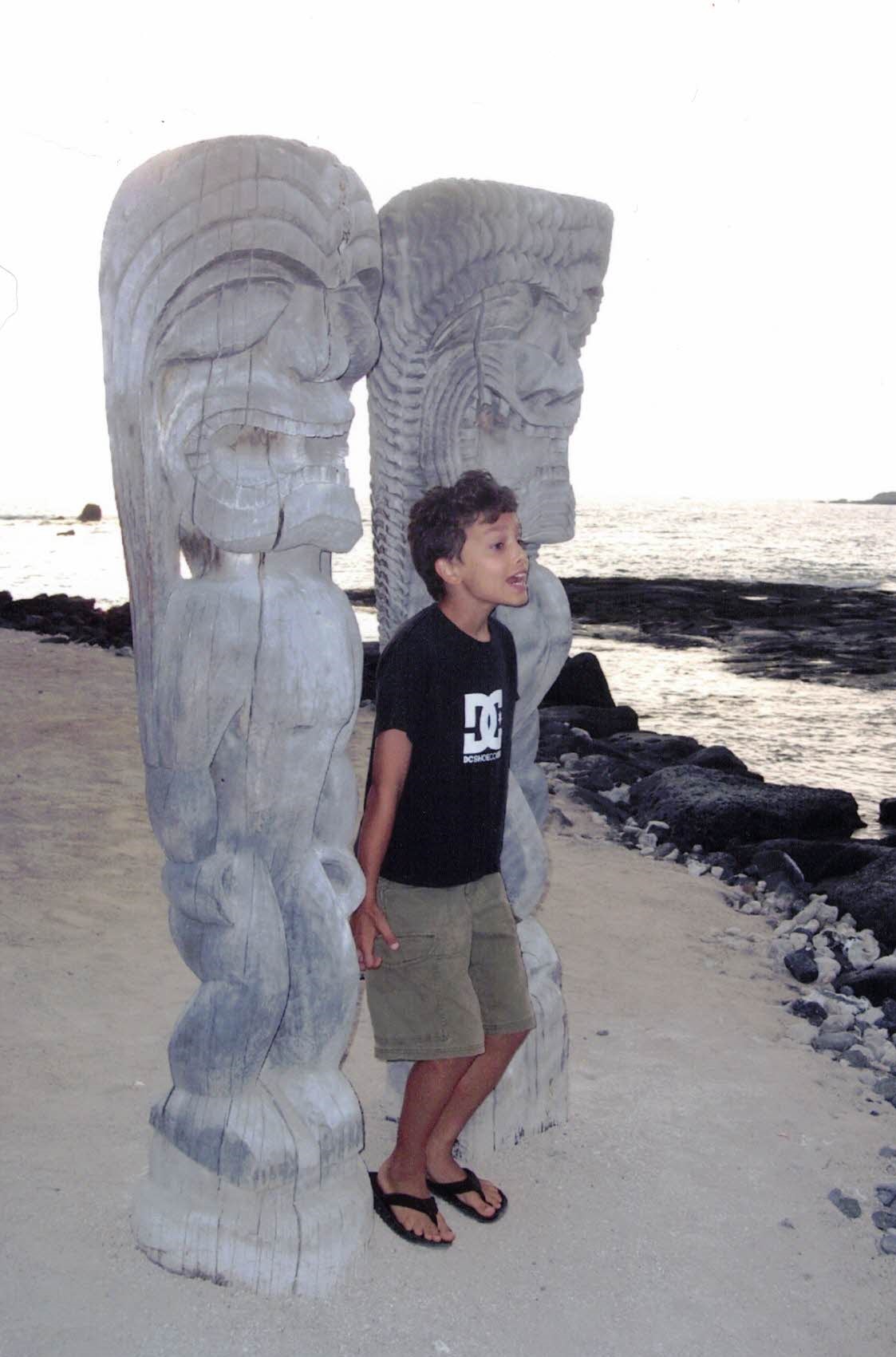
Neil, age 11, being a tiki at Pu’uhonua National Historical Park, Hawaii, 2006