Monthly Archives: May 2010

Pun and Games

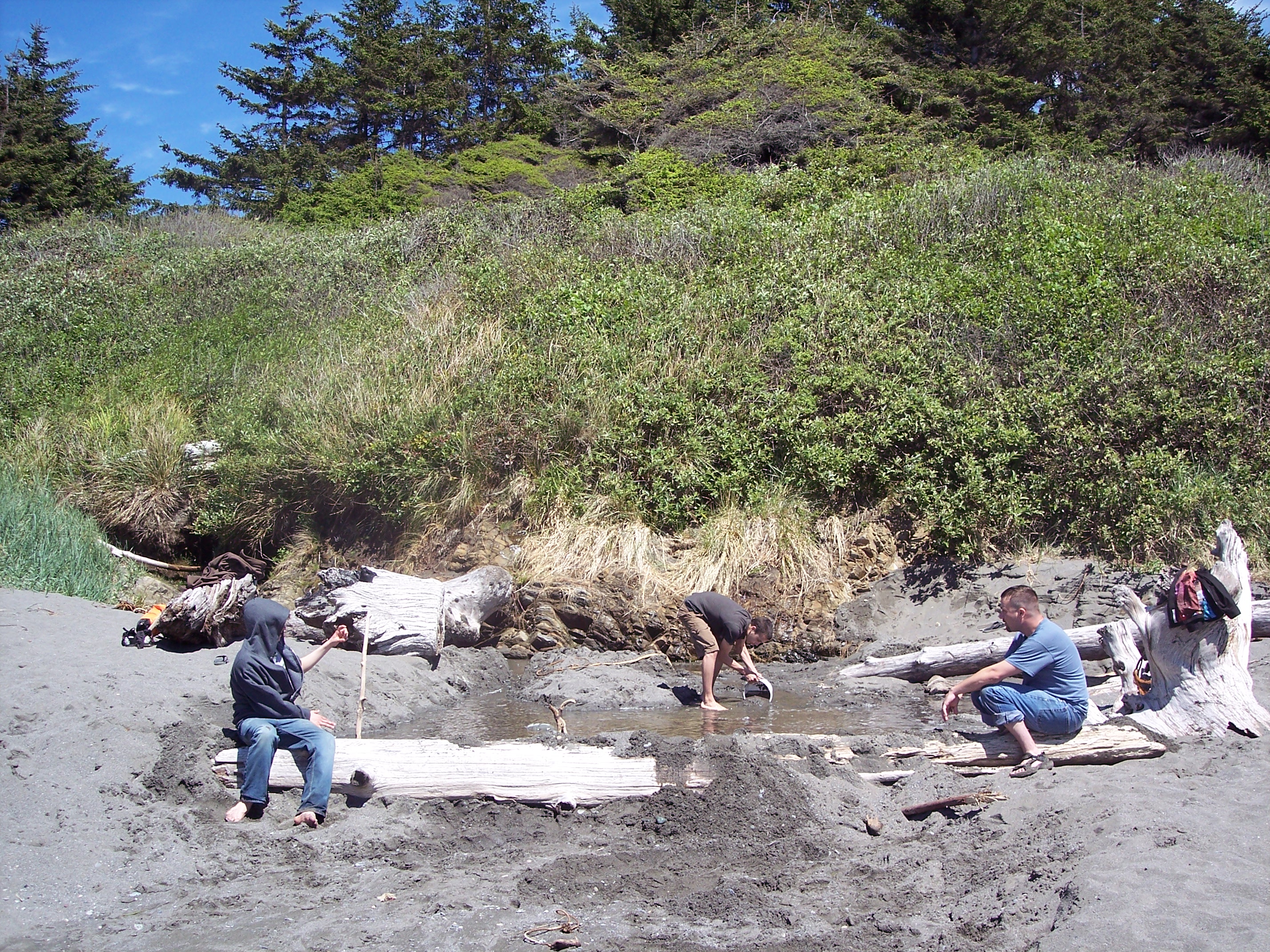
The Scene:  Sunny but cool day on the Oregon coast. Waves crash on the shore, birds call as they fly overhead, and a few people walk by with their dogs. A small waterfall rushes out of a fern-covered hill at the back of the beach. The water gurgles over a rocky area and forms a little creek that meanders out to the sea. Two teenage boys and their uncle are building a dam out of logs, dried grass, and sand. Nearby, a woman watches as she reclines against a large driftwood log and enjoys the sun.  She is glad that the boys are outside instead of sitting around in the cabin they had rented for the weekend, watching more DVDs than most people could watch in a fortnight. The dam is working; a pond forms as the water collects, and the older teen boy stands in it while pouring sand out of a bucket.

Teen boy (calm, even voice):  This water is damn cold.

The woman, his mother, thinks it is probably a line from one of the movies he had watched the previous night  – The Abyss – which involves a lot of cold water. Her son repeats the line a few times, and the mother realizes that he is most likely expecting a response from her.

Teen boy (fourth time, in same tone): This water is damn cold.

Mother: Yes, I’m sure it’s pretty cold.

Teen boy (same tone as before): This water is damn cold [gestures to the dam wall, then smirks]. Get it? ‘Dam cold’?

Believe

I just finished reading an amazing book called Fearless Nest: Our Children As Our Greatest Teachers. So many of the beautiful stories in the collection resonated with me. And one thing the book really has going for it is that my friend Carrie is one of the contributors! In addition to that, it got me thinking about what I have learned from my children. What I’ve learned from Adam deserves a post of its own, but for today, I’ll write about what I’ve learned from Neil.

It’s the power of belief.

But I’m not just talking about the belief I have in his potential, or that he would learn to talk, that he could be mainstreamed in school, that he would learn to regulate his behavior. All of that involved a tremendous amount of belief, and, for that matter, it still does. Because I truly believe, in spite of all his challenges both past and present, that he will be able to navigate adulthood with some degree of independence. Most of all, I believe he will find people who will appreciate him, and he will have friends and be happy. Even if his connections aren’t typical, I believe this with all my heart.

And I believe that he will follow his dreams in adulthood, because he already does. Since his early years he has been a huge Disney fan. He loves the characters so much that he thinks of them as friends. In fact, his stuffed Tigger prompted him to speak one of his first words and start showing some imaginative play. These days, he owns almost all of the Disney movies, animated and live-action, the older ones as well as the newer ones with Pixar, and he rotates watching them. These movies have taught him how to talk, how to interact with people, and how to tell a story, among many other skills. But mostly, they comfort and entertain him. They are a big part of his life and he loves them.

For a few years now, he has talked about a movie idea he has that combines all of his favorite animated Disney characters. I’m not clear on the plot details, but it involves him becoming an animated character and going into their world (a la Roger Rabbit, I suppose) to help save them from a new Disney villain, worse than all the Disney villains combined. A few weeks ago, he wrote a letter to the Disney Corporation outlining the plot and asking if they would be interested in his story idea for a future film. He typed it on his computer, printed it out, folded it up, put it in a #10 envelope, and addressed it by hand, which is no small feat with his dysgraphia. He sealed the envelope and came to ask me for a stamp. I mailed it the next day, not knowing what he had written, but hoping that it was coherent enough for them to at least send him a form letter thanking him for his interest. I told him that the Disney Corporation probably receives hundreds of pieces of mail daily and that it might take several weeks before he received a reply, if any. I tried to let him down easy, gently prepare him for disappointment.

But he believed.

My boy believed so strongly that he would receive a reply within two weeks. After the first week, he said to me, “It’s been a week now. My response from Disney should be arriving soon. Let me know when it comes in the mail, okay?” And I again reminded him that Disney may not be able to answer every letter they receive, etc. Still he believed. And I suppose I should not have been at all surprised when, on day eleven, a letter arrived from the Disney Corporation addressed to my son. He was shaking as he opened it, saying, “I knew they would reply!” And they did, within the timeframe that he believed they would. It was such a generous response – not a form letter at all. The kind soul who had opened my son’s letter had taken the time to write a personal response. She told him that they would probably be interested in his idea (he loved that part!), but diplomatically – gently – explained that due to legal restrictions, they could not pursue it. And Neil handled it very well. He said that he understood and was okay with it. He got his response, addressed to him on Disney letterhead, and that was enough for now. His belief came to fruition.

And what do I believe? As we go forward with our out-of-state moving plans, I find myself faced with several huge unknowns, especially now that Neil won’t be attending the special school we’d hoped for, at least not for a while. I don’t know where the boys will go to school. I don’t know when my house will sell. I don’t know where we’ll be living. I don’t know what job I’ll have. There is so much I don’t know. But Neil has taught me to believe. And I believe that everything will work out as it should. I believe that all of our needs will be met. I believe that all that I seek is seeking me. I believe that all will be well. And that is enough for now.

A Second Thought

The Scene:  A mother is driving home from work. After eleven miles, she is back in her town, and remembers that she had driven her older son to school that morning instead of having him ride his bike because it had been raining heavily.  She turns around, goes back to the high school, and pulls up to the curb in front just as her son, who is already outside,  starts looking around for her. He gets in and the mother starts driving home. Then she remembers that she needs to go to the post office to check the mail, since they do not have mail delivery to their home, and she turns around and drives back towards the post office. She parks and gets out of the car while her son waits in the passenger seat. She goes in the building, opens and looks in the box, and there is nothing there. Realizing that now she is late getting home to let her other son, the bus-rider, in the house and that he is probably waiting in the rain, she jogs back to the car and gets in.

Mother: Well, that was a waste of time.

Son: No mail today?

Mother (backing out of the parking space): Nope.

Son: You should have made it a second thought.

Mother (pulling out of the parking lot): A what?

Son: You should’ve made getting the mail a second thought.

Mother (pauses as she turns onto the main street, somewhat flustered): I don’t know what you mean by “second thought.”

Son: You know how you people are always saying things like, “On second thought, maybe I won’t . . . go to the post office.”


Image credit:  Young Tran

Some Good

Like most people, when I was in school (mostly college), I dreaded exams. I much preferred those classes in which the final exam was a paper or a project. Because as much as I could prepare for exams – researching, studying, memorizing – it gave me such anxiety knowing that I would have to retrieve all of that information in a limited amount of time and use it to prove that I knew what I was talking about. So much was riding on it, and I usually doubted how well I would do.

Yesterday, we had a very important IEP meeting for my son who has autism and is now in high school. He requires constant assistance to start, work on, and complete assignments at the public school where he is mainstreamed with extensive support. While we are very fortunate to have that support, I do not want his potential limited by a modified diploma. He needs to be taught to work independently, and I don’t see how that could happen in his current placement. We found a school that specializes in teaching ASD students, and he has attended summer camp programs there. I asked his current school to change his IEP to reflect that his academic needs would be better met in the special program.   

I prepared for this meeting for two weeks. I researched online, I consulted other special-needs parents, and I printed out e-mails from my son’s special education teacher that I had saved over the course of the school year, mentioning various times that she’d had trouble getting him to do the work, and in which she was asking me for advice. I built a case showing that although I appreciate the support that my son receives, his academic needs were clearly not being met. I practiced my main arguments in my head for days. I threw all of my energy – mental, emotional, and physical – into my preparation. I meditated. I prayed. I tried not to lose sleep. I did everything I could.

But this was one exam that I could not pass. From the moment I sat down at that huge, intimidating table, the district special education coordinator controlled the meeting. She knew how it was going to go. She was diplomatic and acted sincere, but she did her job for the school district. No matter how convincing my arguments, no matter how irrefutable my evidence, no matter how much I stuck to the facts and did not let my emotions surface, she did not waver. It didn’t matter what I’d said or how many e-mails I produced. I felt railroaded. We never had a chance.

I left the building and the tears immediately streamed down my face. I couldn’t even make it out to my car first. I was not completely surprised at the outcome of the meeting, but still, I had hoped. And it was quite a blow. I know that I could hire a special education attorney and take the district to court. I know that we have a good case. But I also know that there’s only so much I can take. I’m supposedly so “strong;” I’ve been told that many times over the years. But I’m not. I’m tired. I’m vulnerable. And I’m not going to fight that fight.

But I will continue to work for what’s best for my son, even if it turns out to be something different than what I’d thought would be best. When I tell Neil, after I’d come home, that the district would not approve transferring him to the special school that he wanted to attend, at first he’s angry. “We need to call the authorities!” he proclaims. But after a few minutes, after he feels my calmness and acceptance, and after we talk about our alternatives, he sighs and goes back to the cartoon he had been watching. I walk out to the kitchen to begin making dinner.

I think about the huge changes that my son – that all of us – will be facing very soon as we move seven hundred miles away to be near the special school in Los Angeles. His father lives there, and my two sons have spent the past eight summers there. They’ll go to the local public school, and we’ll just keep working to get Neil in the one we want him to attend. But I’m open to the possibility that maybe something else will come up in L.A., some other opportunity that will turn out to be even better for him. Something we hadn’t even thought of. After the meeting, walking out to the car, I felt so disappointed in myself because I knew that I wasn’t going to fight the school district. I felt like I was just giving up. But now I see it differently. It’s not surrender; it’s hope. Hope for something better.

A few minutes later, as if he picked up on my thoughts, Neil walks through the doorway of the kitchen, stands there for a moment, and says, “Maybe some good will come of it.” It was most likely a line from a movie. But it couldn’t have been better said. I put my arm around his waist and pat his back and tell him Yes, honey. I’m sure of it.

Please

We all have dreams for our children. Autism doesn’t take away our dreams – it only changes them according to our child’s abilities. And so, we still dream.

My dreams for Neil have certainly changed over the years, but I still have them. And so does he. Some of those dreams have come to include the possibility of a post-secondary education, which seems out of reach given his academic challenges and the lack of local resources to address those challenges. So, we found a resource – a special school – that can teach him the skills he needs to be able to work independently, and I foolishly believed that all I needed to do was fill out a bunch of paperwork and enroll him.

I had no idea that the administration at his current school might not agree that this is something that he needs. I had no idea that they would be reluctant to change his IEP to reflect that his academic needs would be better met in a non-public school setting. I had no idea that the minor hoops I envisioned jumping through would turn into major hurdles.

The special school we would like Nigel to attend costs more per year than my entire college education did. Even when I sell my house I will not be able to pay the tuition out of pocket. However, we can receive funding if the change is made to his IEP, if it designates that his needs would be better met in a non-public school. I approached the special education coordinator at Neil’s current school, and she discussed it with the district sped coordinator. They declined our request, stating that Neil has made progress and “is capable with supports to maintain grades.” We have an IEP meeting scheduled next week to discuss this further. Neil’s father, who lives 700 miles away, will attend via conference call.

Yes, Neil has grown. He has come so far. But the fact is that the progress he has made has been behavioral and social. And while this is indeed wonderful, his academic needs are not being addressed. The grades that he “maintains” are heavily modified. The teachers do not even assign him homework! He can barely complete the class assignments, even with constant assistance. I know that they like him and care about him, but it appears that they are just pushing him through. If he cannot work independently, he will not be able to attend college. It’s wonderful that he receives so much academic support; the special education coordinator helps him every day to do his work. But he needs to learn the necessary executive function skills to be able to do it on his own, and I don’t expect him to learn that in a public school setting.

I know that some of the professionals who have worked with my son have read this blog before and might be reading this post. I really hope that they do. Because I want to say this to them:  Please. Please think of Neil’s academic needs. Please think of the dreams that he has. Please give him the opportunity to utilize the best academic resource that is available. He needs more specialized instruction than what you are able to provide. I do not fault you for this, especially since he is only the fourth ASD student to attend your school. I truly appreciate all that you have done for my son. Please just do this one last thing for him. Please.

Motherhood

I never thought it would be like this . . .

That my child would cry so much for so long

Or have great difficulty in learning to talk

That one would shriek and writhe on the floor because someone flushed a toilet or turned on a coffee grinder

And the other would only eat four foods and couldn’t learn to ride a bike

I never thought that my children would have special needs

That I would be a single parent

That I would have to attend so many meetings and therapy appointments

That I would have to mastermind my son’s education

That I would be forced to homeschool him for eighteen months

I never thought that my older son would wander and get lost

And that my younger son would have to help look for his older brother

Or that I would still grieve whenever I heard young children who could talk . . .

I never thought my heart could be so full

*

I never thought it would be like this . . .

That one child would learn to read at age three and the other at age nine

That the one who lacked imaginative play would someday love fiction

And the other, who couldn’t hold a pencil, would become an artist

I never thought it would be so monumental to take a nine-year-old into a grocery store without a sensory meltdown

Or that a fifteen-year-old’s first unprompted ‘thank you’ would be so gratifying

I never thought that one son could play on a team sport, attend a concert, or enjoy the theater

Or that the other son would design his own video games and become a voracious reader

I never thought anything could give me as much peace as when they get home safely each day

That there would be so many “little” things to celebrate

Or that through my sons I would meet such wonderful friends of my own

I never thought that the emergence of voice inflection would be such an unexpected gift

Or that I would weep with joy when my son made a new friend . . .

I never thought my heart could be so full

Questions

The Scene:  Interior of suburban family home. A mother, exhausted from just another regular day, collapses on the couch in her living room. She has just completed her responsibilities for the evening, taken a shower, and dried her hair. Alone, looking forward to some time to herself, she takes a deep breath and picks up a book that she hadn’t been able to get back to for several days. A minute later, one of her teenage sons opens the door of his room and walks down the hallway. He stands at the entrance of the living room, waiting for his mother’s attention. She turns her head to look at him, thinking that he’s going to announce some historical or scientific fact that he has just discovered. Or that he’s going to remind her once again about the Goonies 25th Anniversary Event that he wants to attend the following month, in a city four hundred miles away. Or that he’s going to announce that he has to go to the bathroom.  His tone is serious as he begins talking.

Teen son:  My path is not out here [gestures to indicate the area in front of him], but in here [lays his fist over his chest and pauses before continuing.] Even if I find answers at that school in L.A., I will still have questions.

Freestyle

About a year and a half ago, a fairly new friend of the family came over for a visit on a day that Neil had forgotten to take his medication. Behaviorally, he was difficult – highly agitated and unfocused.  At one point, when he was prevented from doing something that he wasn’t supposed to do, he went into full meltdown mode, growling and writhing on the floor, grabbing my legs and biting them.

Our friend tried to put a humorous spin on things. “Oh, he’s freestylin’!”

“Yeah,” I said, yanking a leg out of my son’s grip. At the time, it was painfully obvious that Neil very much needed his two types of medication to manage his behavior, both at home and at school. And it made a huge difference for him, enabling him to be mainstreamed with assistance and – unless a dose was forgotten – eliminating or subduing his meltdowns. I think both of us were relieved by it.

But, like most medications, his has its drawbacks. In addition to Neil’s excessively itchy scalp, it also caused noticeable joint stiffness for which he needed to see an orthopedist. And then there was something noticeable only to me – his eyes. I didn’t get to see much of them anyway, but I saw them enough to know them. Now when I looked in his eyes, there was a listlessness – a vacancy – caused by the medication. I wanted his behavior to change, not his countenance. Of course I welcomed the behavioral management, but his eyes were different. He didn’t look like himself, even when he smiled. I looked forward to the day when I could look into his eyes and see him again.

That day came last week.

This past November, we discontinued the antidepressant, and he did fine with that. Every week afterward, Neil kept asking me when he could stop taking the other medication, and as much as I also wanted him to stop taking it, I wanted to be sure that he was ready. If not, we could have him go back on it, but that would have been difficult after the six-week weaning process (cessation can cause withdrawal symptoms if not done gradually). In March, I felt that he was ready, and we began the process. There were a few times when I wondered if it was too soon, but we pulled through. In fact, Neil’s overall adjustment has been phenomenal. During that six-week period, we had two weeks of considerable upheaval while all of the flooring in our home was being replaced. Every room of the house, including Neil’s, had to be completely emptied and furniture had to be relocated, including pieces of our sectional couch being kept in the kitchen for three days. Neil was a bit on-edge during that time, and his medication was down to half-dose, but I am thrilled to report that he did not have a single meltdown. Not even close.

He became a little agitated at school during the weaning process, but he worked through it. This is huge progress for him! In the past, his agitation would lead to outbursts because he could not regulate his emotions or behavior. And now he can. The real test came last week when he was completely unmedicated and we attended his Court of Honor to receive a Scout rank advancement that he’d worked toward for two years. He had a new merit badge sash that he spent quite a bit of time applying his merit badges to, and he looked forward to wearing it. That night, we ate dinner and then got ready to go to the Court of Honor. After he dressed in his uniform, Neil built some Lego while I washed the dishes. When it was time to go, I grabbed my camera and my dessert contribution, and then we left. The meeting room, before the presentation started, was unstructured and loud with parents chatting and kids playing, and I looked to see how Neil was handling it. I could tell he was getting a little amped up, and then I noticed that he had forgotten to wear his new merit badge sash. I had to tell him before he discovered it during the presentation, which could have been disastrous.

I approached him quietly and broke the news. Angrily, he sucked in his breath and clenched his fists by his side. “It’s okay,” I told him. “Look – several of the other Scouts forgot their sashes too.” I could see him processing, regulating. Within ten seconds he had unclenched his jaw and fists and merely sighed in disappointment. “I was distracted by the Lego,” he muttered.

Sighing and muttering. This is freestyle now, and it’s a far cry from growling and writhing on the floor. In addition to that, he reported last week when he got home from school that for the first time ever he did not feel drowsy during second period, and he feels like he’s able to focus better. His scalp no longer itches. To top it all off, the next night at dinner he looked at me as he described a new movie idea, and he held eye contact for the longest I’ve ever experienced. It was incredible. And this time, the vacant look was completely gone. It was Neil again. I gazed into his beautiful eyes, absorbing his essence.

I’ve got my son back. And he’s better than ever.


Image credit:  Dalibor Ogrizovic