Monthly Archives: January 2010

Deepest Desire

The Scene:  Interior of a suburban family home. The autistic teen has been spending most of a Saturday afternoon in his bedroom, at his computer, playing a CD-Rom game in which the player constructs and runs a Jurassic Park-themed attraction. He has owned this game for about eight years and goes through phases in which he plays it for days on end, and then moves on to some other Obsession of the Week. But he never lets more than a few weeks go by without playing this game again. It is his favorite “video” game. He studies the screen now, makes some changes to the sauropods’ feeding schedule, and gets up out of his chair. He walks down the hall and enters a room on the right – his mother’s office. She sits at her desk staring at her computer screen; spreadsheets surround her. He stands at the open door, and she looks over at him with an expression of confused amusement as he makes his announcement.

Autistic teen:  My deepest desire is to build a Jurassic Park and have a girlfriend.

Mother: Okay. We’ll see what we can do.

Image credit:  Nadia Szopi?ska

The Lowdown, Vol. 2

It’s time once again for another edition of Personal Posts! Some might recall that I started this series of posts back in November and, well, I started it. I haven’t written any additional posts on it since, and I figured it was time. Because, you know, I have such an exciting life and all.

When we last left off, I was not dating, and that is still the case. My co-workers and I recently had a good laugh over some headline we read that Kate Gosselin, with her new long ‘do, wants to start dating again, and I was like, “I don’t have time to date with two kids; how is she going to date with eight?!” But I’m thinking that summer might be a good time for me to try. That gives me ample time to finish up some projects and grow my hair back out. I had my hair cut a couple of weeks ago, and even though I went to the same stylist who’s been doing my hair for about five years, and even though I brought a photo of myself with the cut that she did last time that I loved, she wasn’t able to replicate it. It turned out completely different, and way shorter than what I asked for. And since, unlike Kate, I’m not into hair extensions, I’ll just have to wait a few months for it to grow out.

Next up is something I’m truly excited about – my plans to gradually switch to what’s called a raw vegan diet, or simply, raw foods. Back in September, I realized that I never felt that great. I felt like every morning I had to drag myself out of bed and had so little mental and emotional energy. I wasn’t sick, but I didn’t feel completely well. I had found out about the raw food diet through one of my clients at work, Raw Family Publishing, a year and a half ago, but at the time it wasn’t something I felt compelled to pursue. In September, I felt drawn to research raw foods due to my low energy level, and I read 12 Steps to Raw Foods. An entire chapter was dedicated to the subject of increased energy as a result of eating raw foods, along with many other positive effects. This is it! I thought. This is what I need to do!

But I knew that such a huge lifestyle change would need to be gradual for me. There are people who go 100% raw all at once, but I knew that wouldn’t work for me since I have two teenagers for whom I still need to cook. So I decided to start off with my breakfast and make that completely raw by drinking green smoothies every morning. I bought a Vita-Mix high speed blender (an investment, but worth it), and since the first week of November, I’ve had them every day. I’m convinced that when I was sick last month it would have been much worse if I’d not had my daily green smoothies. I’m addicted to them and cannot start my day without them! Since I asked Neil and Adam to be supportive, they humor me and refrain from making comments (especially the one who thought it would be a good idea to make a pizza smoothie). So I’ve got the raw breakfast down pat, and I’m slowly working my way toward a raw lunch, which I hope to accomplish in the next couple of weeks.

The progress on publishing my book came to a grinding halt when the holidays hit, and if I don’t get back to it soon I won’t be able to live with myself. Unfortunately, this time of year is my busiest with my second job, which is seasonal. For my primary job, I am an account manager for an order fulfillment company. One of my accounts is a music label with about 50 artists, and for my second job, I do their semesterly royalty calculations and statements. I’m about neck-deep in spreadsheets now. So, my friends, I’m afraid I’m going to have to cut back on posting and blogging (wah!) for a bit until I meet my deadline (meh).

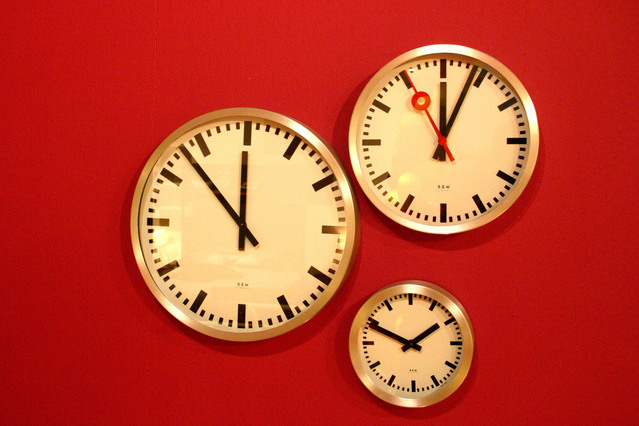
If I can, I’ll pop in every now and then with a Neilism or something, like yesterday when he got home from school and decided to take inventory of all the clocks in the house – his watch, everybody’s alarm clocks, the living room clock, the microwave clock, and whichever ones I’m forgetting. He then came into my office and announced, “Looks like all our clocks are out of order. But mine is the right time.”

Ba-da-bum. Cheers!

Image credit: Patrick Nijhuis

What We Know

Love, the simplicity of it

At first, that is all we know

When our children enter our lives

Some of us learn early on

That things will be different

That our lives will take an unexpected turn

Some will find out later

That we must take on a new persona

And ask questions without answers, such as

Why

But some of our questions will be answered

In time

We will come to know

More about ourselves

Than we ever expected to

We know that we are vulnerable

No matter how many well-wishers

Revere our strength

We know how hard it really is

Love, the complexity of it

We know

That there aren’t any instruction books

Yet we keep reading them

We acclimate to our reality the best we can

And when we think of our children’s futures

Ultimately we will come to realize that

So much of what we know

Is what we don’t know

And we learn to live with that

Through it all, we come back to the one constant

That keeps us moving forward

When everything else is stripped away

The reason why we have been here all along

Why we do what we do

How we know

What we know

Love, the simplicity of it

A Little Boy’s Dream, Part 2

When Neil started wrestling two months ago at his high school, I was elated and optimistic. This, as I wrote previously, was something that he’d wanted for a very long time, and he made it happen. Surely that meant that this was the beginning of great things in his life, that this would be his niche, that by junior or senior year I’d be attending state championships and even nationals with him, filming him as he won matches, cheering, crying with joy that he achieved success on his own terms.  I could see it happening. I could almost feel it. I wanted it for my son. But I knew that his first season would be a time of learning, since he hadn’t wrestled before, and I had talked with him about not feeling bad if he lost a lot of matches his first season. I told him that I had heard from other parents that their sons lost a lot of matches their first season, but they just kept practicing, and by their second season, they were winning matches.

The season is now two-thirds of the way over, and he has not lost any matches. But that’s because he hasn’t been in any matches. He hasn’t been in any tournaments. The only time he gets to actually wrestle is during practice. At least, that’s what I thought.

I picked him up from practice last week, as I usually do. He got in the car, I asked him how his day had been, and he said, “Fine,” as he usually does. I pulled out of the parking lot and began driving home. And then he said something that made me want to sob.

“I think there must be an odd number of people on the team, because whenever it’s time to pair up for practice, I always end up without a partner.”

He had said it with trust and diplomacy, without blame, and without self-pity. But I could hear his underlying disappointment. I could hear the frustration he’d learned to suppress from years – a lifetime – of being left out. Of not being understood. Not being accepted.

A few weeks ago, it was proposed by his case manager and the coach that we reduce his time at daily practice because he was complaining of being too tired to do his school work, and I had agreed. But I didn’t know that he was being excluded during practice, and I wondered how long it had been going on. I took a deep breath.

“Have you talked to the coach about it?” I asked. As much as I want to jump in and be mama bear, I am trying to hold back and give him the support to advocate for himself.

“Yes. But I don’t remember what he said.”

“Well, maybe you could talk to him about it again, and suggest to him that if there is an odd-numbered amount of people, that perhaps a few could rotate. Since you leave early, you could work with someone first, and then when you leave, the other person would get their turn.”

“Hey, that’s a good idea,” he said with interest. “I think that would work.”

 *

Five days later, I ask Neil if he’d talked to the coach again, and if he’d been getting a partner at practice.

“Yes, for a little while,” he says. “But I’m starting to think that this being thrown around all the time is too hard on my body. Wrestling’s not how I thought it would be.”

This is new information, and part of me suspects that he’s trying to talk himself out of wrestling because he hasn’t been in any matches or tournaments. I remind him that the first season is a learning season for everyone, and ask him if he would like me to talk to the coach about making sure that he gets to do at least one match before the season is over. He declines my offer. I remind him that he’d been wanting to do this since he was a little kid.

“Yeah,” he says. “And I did it. I wanted to be on the high school wrestling team, and I am. That’s all I really wanted to do, besides inventing a time machine and being the first human on Mars.”

And it hits me – he just wanted to be on the team. That was his dream. Not finding his niche, or going to state championships or nationals – those were my dreams. And as long as he’s happy that he followed his dream, that’s all I really care about. I put my arm around him and tell him how proud I am of him. I ask him if he’d like to continue practicing the remaining four weeks of the season.

“No. I just don’t think wrestling’s my sport. It’s too painful. But I’m glad I tried it, despite the fact that it wasn’t what I thought it would be.”

I tell him that I’m glad that he tried it too, and then we go over what he should say when he calls the coach to tell him that he’s not going to do wrestling anymore. I remind Neil that he should tell the coach thank you for the opportunity to be on the team, and that it meant a lot to him.

It meant a lot to me, too.

Stretching

Remember Silly Putty? You could pull it apart slowly, and it would keep stretching and stretching and stretching. But if you tried to pull it apart really fast, it wouldn’t stretch. It would snap.

Sometimes I feel a lot like Silly Putty, trying to stretch to accommodate all of the elements of my life. But I think that the hardest part for me, besides my sons’ father living far away, is being pulled in two directions trying to meet the needs of both of my boys. I feel like I’m just stretching and stretching. Most of the time, I can keep stretching, and I do. But sometimes, too many things that require my attention happen at once, and I reach a breaking point.

Take last weekend, for example. Nearly all day Saturday was spent doing Neil’s Boy Scout event with recycling Christmas trees. We got home from that, I made dinner, cleaned up after dinner, and started doing some work that was due for a client. I figured I could finish it by Sunday afternoon before heading out to the animal shelter to do the weekly volunteer work that Neil needs for a Scout requirement. Then we’d get home, I’d make dinner, fill out some paperwork that needed to be done, and that would be the end of the weekend. No down time. I felt really stretched.

So I was sitting at my computer, working on some spreadsheets, and Adam walked in to ask me to take him to the mall tomorrow so that he could trade in some old video games and get a new one. I sighed, trying to avoid snapping. I felt like I was being pulled apart too fast. I started to complain about how busy I was, being gone all day at the Scout thing and having work to do, and the animal shelter tomorrow, and more work, and . . . Adam’s face fell. He started to walk away.

And then it hit me. Again. I do so much for Neil. He requires so much of my focus and time. And Adam asks for so little. How could I not do this for him? All I needed to do was stretch a little more, to make a little time for my second son, who so often feels like second fiddle.

“Wait, honey,” I said. “I’ll be able to fit it in. We’ll go right after Neil and I get back from the animal shelter. And after the mall, we’ll go out to dinner, okay?”

“Okay. Thanks, Mom,” he said, his face brightening some.

And that is what we did. Sunday afternoon, Neil and I got back from the animal shelter, and Adam had his bag of old games all ready to go. I changed my clothes for dinner, then we drove to the mall and exchanged Adam’s games for the new game that he wanted, and he was happy. We went to the restaurant, and Neil, without prompting, actually thanked the waiter when his plate was set in front of him. That’s twice in one weekend, for anyone keeping track!

And I’m so glad that I stretched myself a little more. It’s often a huge challenge doing this on my own, but it’s worth it to keep stretching. It’s worth it to make sure Adam knows that he’s also my priority. Fortunately, I’m a lot like Silly Putty. When it snaps, you can easily connect the two ends together again.

An Open Letter to My Son’s Teacher

Dear Neil’s Teacher,

At the Scout meeting on Saturday, I know that you were laughing good-naturedly when Neil worded something in an awkward way, and that you didn’t mean any harm, but I wanted to clarify for you what I said in response, because, as his teacher, it’s important for you to know. Neil did not start talking until he was five years old, and the process from that point on was very difficult for him. I described this in the information sheets that I gave to all of his teachers at the IEP meeting in September in the hopes that his teachers would be patient and understanding when he has difficulty expressing himself verbally. This is one of the many ways that his autism affects him.

When I said, “He does the best he can,” in response to your laughter, I meant that sometimes he is unable to formulate his word choice in a typical way, but he tries. He has always had difficulty using pronouns correctly. Sometimes he states something that’s obvious. Sometimes what he says can sound odd or off-the-wall to others, but he cannot help it, just as [another student] cannot help it when he stutters. When [the other student] stuttered at the meeting, no one laughed. And I really hope that when Neil says something in the classroom that is obvious or might not make sense that you do not laugh in response. This sets a negative example for his peers, many of whom have bullied him in the past. This is why I had homeschooled him previously. It would be very upsetting if the bullying started again, as it would affect Neil’s academics negatively along with his well-being.

As I said, I know you did not mean any harm by laughing. I just wanted to make sure you realize that he cannot help it if he says something awkward. He has always tried so hard to communicate, and when he says something that doesn’t sound right, he shouldn’t be laughed at. Thank you for the work that you do as a teacher, and for your patience with my son. I know that a student with autism can be more difficult to teach, and I do appreciate all of your efforts.

Sincerely,

Tanya Savko

The Little Things

Umbrellas for guests’ use in the lobby of the Hotel Country Villa, Nagarkot, Nepal, during monsoon season

Sometimes the little things* mean so much.

Yesterday, we participated in a day-long Scouting event that Neil’s troop organizes annually – Christmas tree recycling. The Scouts and their parents drive all over our town and the neighboring town, pick up Christmas trees from people’s homes, load them onto trucks and trailers, and take them to a local park where later they are turned into fish habitat and mulch. It’s a great program for the community, and the donations received from it help to fund the Scout Troop’s activities for the year.

Halfway through the day, we break for lunch, which is prepared and served by Scout parents and siblings at the local church where we have our weekly meetings. During lunch, one of the Scout’s sisters walked around the tables refilling drinks for people. Neil was seated at a table near me, and as she passed by, he held up his cup for her to refill. She did, and he said, “Thank you.” He said it perfectly, so naturally, like he’s been saying it all along. And he said it completely unprompted.

My heart raced, and I wanted to stand up and shout, “Did you hear what he just said?! On his own?!” For years, after he finally started talking, I have always had to prompt him to thank someone, whether it’s for a gift, a server bringing him something in a restaurant, me buying something that he wanted, or for anyone helping him in some way. I have repeatedly told him that whenever someone does something for him, even if it’s just holding a door open for him, he should say thank you. And, until yesterday, I had never heard him say it unprompted. The way autism affects him socially, it just doesn’t occur to him to thank people. I think that now, at this age, he understands why he should and that it’s expected, but he usually just doesn’t think of it at the time. He may be battling sensory issues in whatever environment he’s in, or preoccupied in some way that we don’t understand. It’s not because he’s rude and doesn’t have manners. And I know that he does the best that he can, and his family and friends know it too. We don’t hold it against him when he doesn’t thank us.

But the general public doesn’t know or understand, and that is why I have continued to drill into him to say thank you. And that’s also why I write and advocate about autism – so that the general public might start to know and understand, and he can meet them halfway. He won’t always say thank you when he should. He can’t always say thank you. But he tries. And when he does, it’s beautiful to hear. It’s a little thing, but it means so much.

*For more not-so-little things, check out my friend Jess‘s Community Brag Page! It’s a great space for any parent of a child (any age) with ASD, whether you are a blogger or not, to contribute to an ongoing celebration of our kids’ amazing progress. Cheers!

The Shower Scripter

The Scene: Interior hallway of suburban family home. The autistic teen is in the bathroom directly off the hallway. The sound of a shower running can be heard from behind the closed door of the bathroom. The autistic teen enters the shower and begins speaking loudly. He is scripting. He begins one of his favorite and most-quoted scenes from The Princess Bride – “Battle of Wits.” His mother, across the hallway in her office, smiles as she listens to him. Last week in the shower, he scripted Peter Sellers and Herbert Lom in an original Pink Panther scene. The week before that, he sang a song from Toy Story. The mother recognizes, since she has heard it so often, that the current scene is nearing its end as her son’s voice rises. She laughs as she hears him deliver the final intonation.

Autistic teen: Never go in against a Sicilian when DEATH is on the line!


Every Morning

Saying goodbye doesn’t mean anything. It’s the time we spent together that matters, not how we left it.          -Trey Parker and Matt Stone, South Park, Tweek Vs. Craig, 1999

I have pulled up in front of the high school and am dropping Neil off in the morning as I have done since he started wrestling two months ago.

“Bye, honey – I love you; hope you have a good day!”

He picks up his backpack and bag of wrestling gear, opens the door and climbs out, shuts the door, and walks into the school without a word, without a glance. This happens every day. And this morning it struck me that even though my son has changed so much in the past ten years, this one thing is still the same. When it’s time to go to school, he doesn’t say goodbye.

When he was five (and for two years before and after), every morning I would walk outside with him when the SPED bus pulled up to the house. I would follow him up the steps of the little bus, greet the driver, and buckle Neil in his seat. I would kiss his head, tell him I’d see him when he got home, bid the bus driver a good day, and step off the bus. Then I would stand in the front yard, smile, and wave goodbye to my son as the bus pulled away. And every day, Neil would stare straight ahead. He would not smile; he would not wave. This went on for five years.

As time passed, he learned to say goodbye in certain situations. For the past two years, I have been able to leave him home alone for short periods of time, and he will respond, “Bye, Mom” when I say goodbye to him. When someone has been visiting our home, he will say “Bye” upon their departure, with prompting. It is never initiated.

As a parent, I’ve learned to just accept it. I’m sure that they continue to work on it in his social skills class. But the fact is that his hard-won ability to talk does not guarantee the ability or the desire to say what society expects. This is one of the many facets of autism. In his mind, perhaps, it is unnecessary to say a parting word upon leaving someone’s presence, especially when it happens the same way every single morning. Or, perhaps, as he gathers his things, steps out of the car, and readies himself to enter a loud, bustling building and function in an unpredictable environment, he doesn’t have the reserves to say anything, to acknowledge me, to be polite. He is too focused on preparing to begin his day at a place that he would rather not be. Even when he is not being bullied, his sensory filters are in overdrive, and his stress level is high. He has to regulate his behavior with both peers and teachers for almost nine hours. And that ain’t easy. I don’t have the heart to tell him yet again that it would be “polite” to say goodbye to the person who drops him off.

And so, tomorrow morning, I will pull up to the front curb of the high school and tell my son that I’ll see him when I pick him up after wrestling practice. I’ll say goodbye and tell him that I love him. And he will pick up his things, get out of the car, shut the door, and continue on into the school without responding. And I will drive off to work and be thankful that, at this point, he does as well as he does. As much as I would love to hear him say goodbye, I don’t need to. I’ll just look forward to the smile he gives me when I pick him up from wrestling practice. That’s worth a million forced goodbyes.

Flying Solo, Part 2

Please wait, an agent will be with you shortly.

Your chat session has started . . .

Micki: Thank you for contacting Economy Air. My name is Micki. How may I assist you today?

Tanya: I have downloaded the unaccompanied minor form for my two children, ages 13 and 15. My question is if the meeting party needs to sign where it says “signature of Party Accepting Custody” when they actually pick up the children, or does it need to be signed by the meeting party beforehand? Thanks.

Micki: 13 and 15 year olds traveling together are not considered unaccompanied minors. The 15 year old is considered an adult.

Tanya: My 15-year-old has autism, and their father still needs to go directly to the gate to pick them up.

Micki: [no response]

Tanya: He’ll be fine on the plane, but we don’t want him going through the airport unaccompanied.

Micki: That is fine. We will document the itinerary so that it’s understood by the agents. All the father needs to do is show his identification at the ticket counter and they will issue him a gate pass to meet the flight.

Those who happened to catch my post a few days ago know what transpired with the December 25th travel plans, and why the flight had to be scheduled that day. But since we had no way of knowing that it would be canceled, the boys were prepped for their first solo flight (!). We practiced lifting up their luggage to put it in the overhead bins. We talked about being patient while waiting to de-plane and not making comments about how people should “just move.” We talked about what to do if for some reason their father wasn’t at the gate when they landed. We went over what topics are not okay to talk about with airport security. Special needs were noted with the airline agent in an online chat that could be printed out for verification. Not surprisingly, there were many preparations for this huge milestone.

And although they ended up not flying that day, we still planned to have them return to Oregon by plane.  I got up that morning and prayed for a fogless arrival time, so that the boys’ plane could land safely. Their father called to let me know as soon as they boarded in L.A. He sounded so proud, describing how he watched the boys get on the plane, and how they waited patiently for an elderly woman in front of them.

When the time came, I drove to our little airport to pick them up. The sky looked good, but as I neared the terminal, my body started gasping involuntarily. It wasn’t a panic attack, which I’ve had in the past. No, it was just a mom, overcome with emotion. I couldn’t help it. Neil was doing something I never thought he’d be able to do! He has come so far, and he never ceases to amaze me.

I parked the car and pulled myself together. I went to the counter to request a gate pass. They hemmed and hawed a bit at first (I wanted to say, So what if they’re teenagers? They are my children, autistic or not, and I have every right to meet them at the gate!), but all I had to do was drop the A-word, and then they were accommodating. The flight was only a few minutes late, and I waited anxiously at the gate.

I was afraid that I would start crying again with their arrival, but as soon as I saw them, my face broke into a huge grin! Adam ran past me, looking unwell. “Mom, I’m sick. I’m going to the bathroom,” he said as he handed me his luggage and took off. “What’s wrong?” I called after him, but he hurried away. I hugged Neil and asked him what was wrong with Adam. He said he didn’t know, and we walked over to the side to wait for him. Neil said that the flight was fine, and then he proceeded to tell me about how, at the movie theater the night before, he threw up twice during the 3-D showing of Avatar. “That 3-D was too good, I guess!” he said with a chuckle. “I’m sorry that happened, honey,” I said. He told me that all the 3-D aerial scenes made him dizzy and sick. I hadn’t even thought of that as a movie-related sensory issue. If it’s not one thing, it’s another!

Adam returned then, explaining that he’d felt a little airsick when they started descending, and then the stuffiness of the cabin and having so many people around him while waiting to de-plane just got to him. “At least I didn’t throw up in the plane,” he said. Yes, at least. Oh, my poor SPD boys! I felt so bad that they had both been sick, especially when I’d hoped that they would enjoy the movie, and later, take pride in their autonomy on the flight. But my concern took a back seat to my overall relief and exhilaration. They did it! Their first solo flight! After many years of effort in dealing with their challenges, it’s so validating to just let them fly.

Image credit: Marcelo da Mota Silva