Teen Autism » 2008 » March

The Responsibility Club

March 30th, 2008

Nigel talks a lot now. Occasionally his syntax is a little off, but he rarely mixes up pronouns as he used to do regularly, and his sentences are now long and complex (often too complex for his peers, and some adults, too!). I love hearing what’s going on in that brain of his, even when he’s complaining about doing his chores, which happens on a daily basis. You have to imagine Nigel’s characteristic deadpan voice as you read this dialogue.

Me: Nigel, it’s your day to do the cat litter.

Nigel: Why can’t they learn to do it themselves?

Me: Why do you ask me that every time? You know that’s not possible.

Nigel: Well, cats should be genetically engineered to clean their own litter boxes.

Me: Well, until then, we all have responsibilities in this family, and today it’s your responsibility to do the cat litter. It’s on your responsibility chart that you look at every day. I shouldn’t have to ask you when it’s your turn to do it. It’s your responsibility.

Nigel: I didn’t join The Responsibility Club. Who invented responsibility? Was it Charlemagne or Aristotle?

Me (unable to respond momentarily due to stifled guffaw): Nigel, just do the cat litter now, please.

Nigel (exasperated, no longer deadpan): Aaaaahhhhh!!!! 

But, he finally did it. We go through this ritual of feet-dragging and complaining with every request for him to complete a simple household chore. I guess that’s normal for any thirteen-year-old. As for mentioning Charlemagne, Nigel read somewhere that education was Charlemagne’s idea, so he figured that the emperor must have also promoted the idea of children doing household chores. Unless it was that idea-spouting Aristotle . . .    

The Autism Club

March 27th, 2008

When I was in high school I had a good friend I’ll call Eddy. Eddy and I were in several of the same classes since freshman year, and by junior year, we had become pretty close. We never dated, but we talked a lot, and one day during class he ran out, visibly upset, and the teacher suggested I go check on him. I found him sitting on the steps of the side entrance of the building, and I sat next to him and gave him a hug. He told me that he was coming to terms with the fact that he was gay. He didn’t know how to tell anyone; he felt confused and a little scared. I assured him I would be there for him.

Months later, Eddy felt better and more sure of himself. His family had responded positively to the news and his friends supported him. He said that he couldn’t believe that it was happening to him. He had read and heard about people being gay, but until he acknowledged that he was, he never realized what it would be like, how it would affect him. He said that he felt like now he belonged to The Gay Club. And that it would determine the rest of his life.

I certainly didn’t feel it at first, but over the years I have come to realize that with my son’s diagnosis I was granted lifetime membership in what I call The Autism Club. I had read and heard about autism, but I had no idea what it was like until I came to live with it. I couldn’t believe it was happening to me. I never realized how it would affect me. It will continue to determine the rest of my life.

I’m sure it’s the same for any parent of a child with a disability. You start going to all the IEP meetings, the team meetings with therapists, the therapy appointments, dealing with trying to take your child out in public, finding a good fit with a program or school and changing frequently when it doesn’t fit. You come to terms with how the disability affects all the family members, now and in the future. You realize that your lives are going to be different than those of your neighbors, and even your friends. You wonder how it will affect your other child, having a special needs sibling.

So you go to the meetings, you do what you need to do, you give attention and show empathy to your other child, and somehow, as the years go by you realize that you are functioning, you are doing this. Life goes on. It’s different, it’s not how you thought it would be, not what you would have wished for yourself and your children, but it’s okay.

Some might think I’m trivializing the experience by calling it The Autism Club. It is in no way trivial, and I know that only too well. It affects every fiber of my being. But I have to keep reminding myself that there are millions of parents of autistic kids, all going through what I go through. And that makes me feel like we’re all part of some special club or association. We didn’t ask to join. But we’re making the best of it. And it’s good to know that we’re not alone.

Making Peace with Autism: A Review

March 27th, 2008

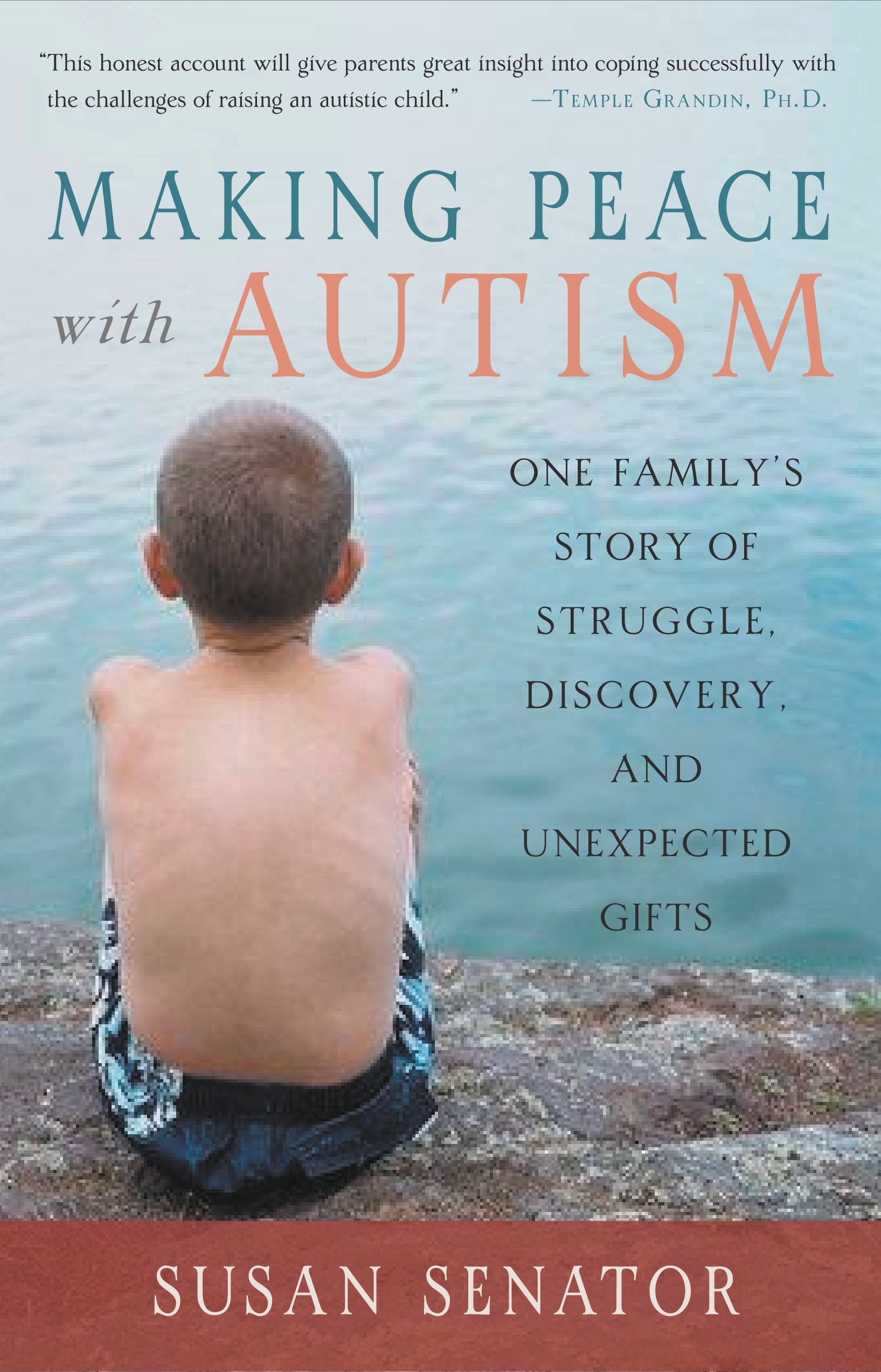
Making Peace with Autism

Even when I had only heard the title of this book, I knew I would love it. I knew it would be the perfect book for me to read.

The approach of accepting autism would have been enough on its own for me to like the book, but Susan Senator’s writing is exceptional, and that is why I love this book. I laughed, I cried, I truly felt she’s been through the same trenches I have. She understands. And she exudes a level of empathy through her words that brought me more comfort than any other book about autism I have read.  

Senator opens with a situation that is all too familiar to many ASD families: something occurs that necessitates making a transition before the autistic family member is ready, and an outburst ensues. Senator drew me in with her description of what happened and how each family member was affected by it, and I certainly identified with all of it.

The book then continues in a chronological format, discussing her son’s early years, how he lined up his toys and stared at them while he sucked his thumb, which was exactly what my son did (although he sucked his index and middle finger instead of his thumb). She discussed her reaction to the diagnosis, going into depth about her emotions and listing all the questions that those of us who have been through it also asked. All the whys, hows, and what-do-we-do-nows. Senator includes a “sidebar” in this chapter called “Suggestions for Getting Through the Early Days, After Diagnosis,” which lists some helpful tips, along with other topics such as “Beginning the Healing Process as a Couple” and “Making Crisis Storybooks for Your Child,” known as ’social stories’ in some areas.

The following chapter describes the various early school programs in which her son was enrolled, and includes tips on preparing for IEP meetings, and what to look for with school placements. This information is invaluable for parents whose child has been recently diagnosed. I found myself wishing this book had been published in the 90s!

The next chapter addresses sibling interactions and traveling, including tips for successful family vacations. Following that is a chapter on sleep problems and the use of medication, with a thoughtful debate on whether to medicate or not. I found this chapter particularly helpful to me because I happened to be making a decision about putting my son on Zoloft right at the time that I first read the book. Basically, Senator urges parents to trust their instincts, which is something I must constantly remind myself, and educate themselves. The chapter also listed strategies for dealing with problem behavior.

The remaining chapters deal with more family issues, such as preparing for a new baby in the house and nurturing your marriage (which I read in a wistful way, mine having ended many years ago). The chapter also mentions important information about leaving your child with others and making sure to carve out time to rest.

At one point, Senator writes: “. . .we moved from grieving over his disability to over grieving what lay ahead for him.” This resonated with me as I made the decision to homeschool my son and deal with all the changes it encompassed. I found Making Peace with Autism to be empowering in the face of my own struggle.

My favorite part of the book is when Senator discovers that her son is trying to connect with her by laughing. I, too, made this discovery with my own son years ago.  My son’s annoying fake laugh is really the way he reaches out, wanting to have fun like everyone he sees around him. He is not completely closed off, in his own world. He has autism, but he is still there with us, interacting. Just on his own terms. It was so affirming to read that other families delight in this discovery as well.

I just leafed through the book again and realized that I had another “favorite part,” near the end. It was when Senator’s autistic son had his bar mitzvah: all the preparations they made, everything it meant to them, the happiness that flooded them with their extended family in attendance. So beautiful and inspiring.

I can’t say enough good things about this book. I think every family trying to come to terms with autism should read it. I also highly recommend reading Senator’s blog at www.susansenator.com. On it, she mentions that she just finished writing a novel. I can’t wait.

Friends

March 22nd, 2008

Nigel has a friend over today, whom I’ll call Riley. Riley has been Nigel’s friend for about five years, and while Riley has several other good friends he would probably rather hang with on a Saturday, he always makes time for Nigel and accepts him, autism notwithstanding.

Nigel has always been a social person, which I think is what propelled him to step outside of himself and learn to talk. When he was about five and not functionally verbal, he would approach NT kids at the playground and try to engage them the only way he knew how: laughter. The problem was that the kids would think that he was laughing AT them, of course, which caused a slew of problems necessitating me to intervene. I think it was because of these unsuccessful experiments in the social realm that Nigel decided if he wanted to have friends, he needed to learn to talk.

One of my favorite sites for autism information is Natural Learning Concepts, which recently posted an in-depth interview with Stephen Shore that I really enjoyed reading. Here is what he says about friendship: “It is my sense that people with autism don’t want to have friends is a myth.  What seems more accurate is that those of us on the autism spectrum have a different way of making friends.”  So profound and yet so simple. I wholeheartedly agree.

Making a friend was a huge milestone for Nigel. And learning how to keep that friend has also been a milestone. It hasn’t always been easy: over the years, Nigel has had outbursts at school, including some resulting in injury to Riley, that I’m sure have caused Riley to reevaluate if it would be advantageous to continue being Nigel’s friend. But Riley does and he is. His presence and his loyalty encourage Nigel’s self-esteem more than anything else, I think. 

God bless the Rileys of the world, and bless their parents for raising them to be such patient, understanding kids. We need a few more Rileys around.

Vaccines

March 21st, 2008

Often over the years I’ve had relatives and friends ask me what my stand is on the vaccine/thimerosol issue. I’ve devised my own theory.

I believe that thimerosol is partly responsible for some cases of autism. What I emphatically believe is that in the last thirty years, large amounts of chemical toxins in our environment (including our food, air, and water) are contributing (not causing, but contributing) to the increase of autism cases, along with increased awareness for diagnosing the milder cases. Thimerosol in vaccines is included on my list of chemical toxins. But I certainly don’t believe that all cases of autism were caused by thimerosol.

When I was six months pregnant with Nigel, I experienced pre-term labor and was hospitalized while I received terbutaline intravenously. I have often wondered if the presence of this chemical affected Nigel’s development in utero. I believe he was genetically predisposed to autism, and the introduction of harsh chemicals through medication I received as well as the aggressive inoculation program thrust upon him after birth caused him to develop autism. It was the combination, not just one or the other.

Hence the variance of the spectrum. I think this theory also helps to explain why some severely autistic children can, with therapy, progress to mid-functioning or even high-funtioning levels, while others do not. It also explains why some autistic individuals respond so well to GF/CF diets, while others do not. Autism manifests itself differently in each individual because there are so many different causes and contributing factors.

I hope I live to see the day when we understand more of the complexities of autism, and maybe have some concrete answers. But for now I’ll have to be satisfied with my own interpretations, which will more than likely continue to evolve. What are yours?

Music

March 20th, 2008

There has been so much research done on music as autism therapy that I couldn’t possibly address the multitude of positive effects from it in one post. What I will do here is discuss the effects that I have seen with Nigel, including increased verbal skills, better sensory integration, and calming influences.

According to the Autism Research Institute, “Autistic children have also made enormous strides in eliminating their monotonic speech by singing songs composed to match the rhythm, stress, flow and inflection of the sentence followed by a gradual fading of the musical cues.” In his early years, Nigel watched a ton of Disney videos from which he learned to use echolalia as a means to communicate. These Disney videos also had songs that he would memorize that taught him rhythm and voice inflection, and from them he gradually gained the verbal skill of using his own words.

As he got older, Nigel began to pay more attention to the music I listen to, which is a mix of classic rock, alternative, techno/dance, world, celtic, and more. I noticed that the categories that feature harder, faster beats (some rock and techno) seemed to help with his sensory integration. He learned how to filter sounds that previously had caused him to go into sensory overload, like air hand driers in public restrooms and other loud, mechanical sounds. And now, he likes the music for its own sake; he rotates his favorite CDs on his own stereo (mostly movie soundtracks like Twister, Back to the Future, and Cars) and sings along.

When he wants to unwind and relax, he turns to some more of my music. I am happily employed by a company called New Earth Records, a spiritually conscious music label specializing in New Age, world, trance, healing music, and Osho meditations. Nigel enjoys the beat and different instruments (sitar and sarangi) of James Asher’s Tigers of the Raj, the relaxing trance rhythms of Cybertribe’s Immortality (Nigel says: “It relaxes away the stress of the day”), and the beautiful melody of Lisa Lynne’s harp on Love & Peace. When I put on Deuter’s Sun Spirit, Nigel commented how much he liked the cover (Van Gogh’s “Olive Trees”) and said that the music made him feel “like you’re in the Renaissance.” Another title of Deuter’s that I play is Earth Blue, which makes Nigel say, “I feel like I want to sleep.” For someone with occasional insomnia, that’s invaluable, as are all the benefits of listening to music.

I highly recommend playing music for an autistic child (and every child), not only as an effective therapeutic device, but also for the soothing value of it. Music adds to the quality of one’s environment and life in so many ways.

Obsession of the Week

March 19th, 2008

Most individuals on the spectrum have what many call “specialist subjects.” These are topics of on-going interest, over long periods of time, that sometimes increase in intensity for various reasons and then abate for a while, but never go away. They usually cover a general area, such as dinosaurs, computers, video games, or in Nigel’s case, natural disasters. He has been interested in natural disasters since he was six years old and I allowed him to watch the movie Twister, which fascinated rather than scared him. Ever since then, he gravitates toward those types of movies and books, and he has expanded the topic to include “unnatural” disasters, such as the sinking of the Titanic. But sometimes these side interests turn into what I call the Obsession of the Week. They hit like a tornado, consume everything, and then they die down.

Obsessions of the Week literally consume him. He can think of nothing else, he does extensive internet searches on the topic, he can talk of nothing else, and I’m sure he lies awake into the wee hours imagining himself immersed in the topic. It is an obsession. His past Obsessions of the Week include Indiana Jones (Nigel became a Boy Scout because Indiana Jones was one), going to Mexico with his classmate’s family (somehow he thought it would be okay for him to go with them on a family trip), running his own Jurassic Park (because of the movie, he believes that dino DNA can be extracted and used to breed dinosaurs),  and taking four fellow Boy Scouts on an Oregon Trail trip, starting in Independence, MO, where they will purchase oxen, supplies, and materials to build a wagon.

I have often wondered where these obsessions come from and how he can become so caught up in them. What purpose do they serve? Is it because now that his imagination is functioning that he’s making up for lost time? Is it because he had to learn to filter out the things that plagued him that he learned to put intense focus on the things that bring him joy? I’m not sure. I do know that even with the problems associated with his obsessions (difficulty transitioning from an obsession-based activity to a non-obsession-based activity, difficulty communicating with him when in obsession-mode, concern about him not getting enough sleep), I still welcome them for several reasons. They motivate him. They encourage self-esteem. They keep him productively occupied. They inspire him. They educate him. They give him something to talk about. All of these things are so important for an autistic teen.

The Obsession of the Week last week was King Kong. We had to rent all versions and sequels of the movies and checked out a book at the library on King Kong cinematography. He put in a request for a King Kong stuffed animal. He watched King Kong-related U-Tube videos. He built King Kong scenes out of Lego. He perfected primate chest-beating.

And now we are into a new week. His father, who lives 700 miles away, is visiting, as he does several times a year, so Nigel is happily focused on spending time with him. They are bowling right now. The only problem is that his dad brought his really cute black cocker spaniel puppy with him on the visit. And Nigel loves him. I think I know what the next Obsession of the Week will be.

Medication

March 19th, 2008

I struggled with this one for a while, not just for Nigel but also for myself.

In late 1997, after crying one afternoon because I could not stop rearranging the chairs around the kitchen table, I realized that the anxiety wasn’t going away on its own. I had several other symptoms as well: peeling skin off the bottoms of my feet until they bled, systematically pulling out my hair, and chronic insomnia. I finally went to a doctor and was diagnosed with obsessive-compulsive disorder. The ‘when it rains it pours’ adage is unmercifully true: my diagnosis came one month before Nigel’s autism diagnosis and my husband’s announcement that he wanted to be separated.

For six months prior to obtaining medication for myself, I had struggled with believing that it was necessary, that it wasn’t a sign of weakness. The doctor had to remind me that if something was wrong with any other part of my body, I wouldn’t hesitate to obtain the medication I needed. If I had a heart disease, I might need antiplatelet drugs. If I were diabetic, I would need insulin. I agreed to a low dosage of Zoloft, and I experienced relief from my symptoms within days of taking it. I took it for a year and a half.

Within the past year, I had noticed that Nigel exhibited signs of anxiety, possibly OCD. He pulled out his hair so much he would create bald spots. He would rub his lips so hard that  he had rough, bleeding patches around his mouth. He had chronic insomnia. I had thought that his anxiety was environmental, due to the constant stress of the middle school. When I pulled him out of the school, his lips/mouth area improved, but he still had insomnia. And the worst thing was that not only was he still pulling out his hair, he had started eating it. I knew then that, even though he was only thirteen, he needed medication. Also, I have read that autistic teens are highly susceptible to depression, and with that running in our family as well, I figured getting him on Zoloft now might cut the depression off at the pass. There are some in my family who think I jumped the proverbial gun, that he’s too young to be on medication, that I should wait and see. But pulling out your hair and eyelashes and eating them indicates a definite need for medication, and I do not regret my decision.

I am happy to report that Nigel is sleeping much better now and has a full head of hair. Life goes on. And I am far too busy to be rearranging the chairs around the kitchen table, thank God.

Seizures

March 17th, 2008

Nigel has never had a seizure, but I have heard and read over the years that adolescence can bring on seizures in previously seizure-free kids. And the possibility has filled me with fear.

Two years ago, one of my co-workers was running some errands on her lunch break, and she had a seizure while she was backing her car out of her space in a busy parking lot. No one was hurt and there were people around who helped her, but it got me thinking and worrying. What if Nigel had a seizure while riding his bike? Just in the past few months I have become secure enough to let him ride his bike alone around the neighborhood. He craves some independence, and so I hold my breath while he is gone for half an hour, hoping he’ll watch for cars, remember to stop at corners, not run into anyone or anything. Not have a seizure. It’s hard to completely let go like that and just trust.

When my co-worker returned to work the next day, my boss made sure that all of us were informed about what to do if a seizure occured in the office (the co-worker had not previously disclosed that she was epileptic). We learned to not restrain her, and to remove any sharp objects in the area. Afterward, we should lay her on her side to maintain an open airway and prevent inhaling any secretions. We learned that she may experience confusion and that someone should stay with her.

According to Autismuk.com, Roughly 25-30% of autistic adolescents have been reported to develop seizures. That’s too high a percentage for my comfort level. But I guess if Nigel did start having seizures we would just deal with it. We’d do what we needed to do, just like we’ve done all along with every other issue that’s come up.

And I would do what I’m doing now: solicit advice from those who’ve been through it. Are there any readers whose children developed seizures in adolescence? Do your children take any medication for it? Please contribute your experience and suggestions. I appreciate your input.

Bravery

March 16th, 2008

Every few years I undergo a relatively drastic hairstyle change. Sometimes it is circumstantial: I am experiencing major changes in some other area of my life, and my hairstyle change is symbolic of that. At other times it’s because my hair is down to my lower back, and it’s just too much work at that length! Off with it!

Last week my hair was reaching beyond the middle of my back, the sun was out, and I had it cut. I think this time it was as much because it was too long as it was a metaphor for the changes going on in my life. I came to the realization a few months ago that Nigel can no longer be mainstreamed, as he was (with an extensive support system) for four years. I radically altered my life, my schedule, my finances, and my ideas so that I could wrap my mind around the concept of homeschooling him, and found ways to make it happen. (I plan to write about that subject in detail for a future post.) And now I am doing it. I drastically cut back on my hours in the office at my job, I found some work I can do from home, and I am now my son’s teacher.

It was a huge change, and I am still reeling from it, even though it is positive. It is scary financially, since I am a single parent. And it comes with so many other adjustments that must be made: emotional, physical, social. So when I’m at the hair salon, and the other patrons and stylists who witness my middle-of-the-back hair being cut into a chin-length shattered bob comment on how brave I am to do that, I say It’s only hair.

Getting my hair cut short doesn’t make me brave. Being a single parent? Sometimes brave. Raising a child with autism? Usually. Homeschooling my autistic son while being a single parent? Reducing my work hours from 30 hours a week to 6, thus reducing my income?

And then I think of Nigel, trying to navigate middle school without any support system in place (how could I have let the IEP ‘team’ convince me that he would be fine with that?!) and dealing with the constant harassment and bullying he experienced, just trying to get through his day, pulling out his hair because of the eternal state of anxiety he was in, and I know. He is the brave one. He was brave to make that first leap to try to learn to talk by repeating lines from videos, trying to fit the lines within the context of the real situation. He was brave to learn how to filter all the mechanical sounds that were agonizing to him. He was brave to want to take the regular school bus, because he wanted “to be like everybody else.” That’s all he wanted, and they treated him so terribly. Yet he went back, every day, and he always tried so hard. Finally, he reached his limit, and he begged me to homeschool him. That was brave too.

Maybe the little things like getting my hair cut short are brave. But when you live with autism, it puts a different perspective on things. And it makes you define bravery in a whole new way.